If You Blink at Me, I'll Blink Back: The 2026 Study Revealing Dogs' Hidden Language
Researchers played videos of blinking, lip-licking and neutral dogs to 54 pets and measured every micro-reaction. The result rewrites how we read canine body language — and how we should respond.

For decades, dog people have traded the same folk wisdom: a long, slow blink is your dog saying "I'm safe with you." It sounded sweet — and a little too tidy.
In February 2025, the journal Royal Society Open Science published the first controlled study to actually test it. The team — led by Chiara Canori at the University of Parma — showed videos of unfamiliar dogs blinking, lip-licking, or sitting neutrally to 54 pet dogs and recorded their reactions frame by frame. By May 2026, the paper had quietly become one of the most-shared canine behavior studies of the year, picked up by iHeartDogs, Phys.org and a wave of trainers rewriting their handouts.
The headline finding: dogs blink back. And that tiny eyelid movement may be one of the most underrated signals in your living room.
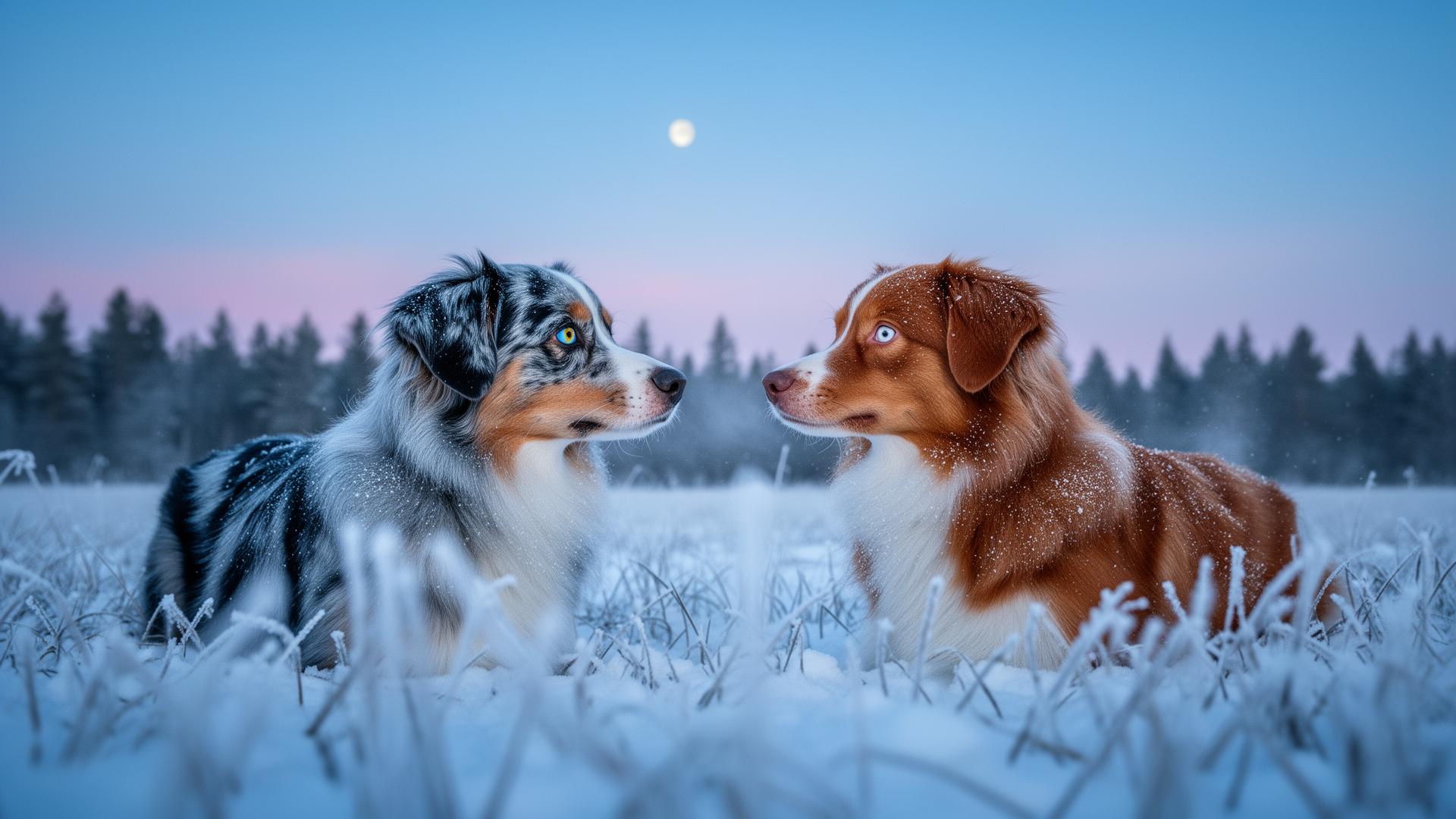
What the study actually measured
The researchers didn't ask owners to interpret anything. They sat each dog in front of a screen, played a 30-second clip of another dog, and counted:
- Eye blinks per minute
- Lip-licks
- Yawns
- Heart-rate changes via non-invasive monitor
- Tail position and movement
When the on-screen dog blinked, the watching dog's blink rate roughly doubled compared to the neutral baseline. Lip-licking did not trigger the same mirroring — and crucially, heart rate stayed flat. That last detail is the important one. Mirrored blinking is not a stress response. It's something else: a social acknowledgement, the canine equivalent of a small nod across a crowded room.
Why blinking, of all things?
In primates — including us — slow blinks function as an appeasement signal. They say "I'm not a threat, and I'm paying attention." Cats famously do the same; the "slow blink" is well-documented in feline literature.
Dogs were the obvious missing piece. They evolved alongside humans for at least 15,000 years, and their facial musculature has measurably changed to support eye-based communication with people — including the levator anguli oculi medialis, the muscle that gives them "puppy-dog eyes." If a species rewired its face for us, it would be strange if blinking didn't carry weight too.
The 2026 follow-up commentary in Animal Cognition put it bluntly: blinking sits in the same family as calming signals first catalogued by Norwegian trainer Turid Rugaas in the 1990s — turning the head, sniffing the ground, yawning. The difference is that blinks are small enough that most owners never notice them.
How to read your own dog's blinks
The study gives us a practical decoder ring. Watch for these contexts:
- A soft, slow blink during eye contact — your dog is comfortable. This is the "I see you, we're good" signal.
- A sudden burst of rapid blinking — mild social tension. Often appears when a stranger leans over them, or another dog approaches too directly.
- Blinking paired with a head turn — a polite request to deescalate. The canine version of "let's both take a step back."
- Blinking with a hard stare absent — relaxed observation, not stalking.
- No blinking at all + a frozen face — that's the one to take seriously. Stillness without blinking often precedes a snap or a bite.
This maps onto what veterinary behaviorists at the AVSAB have been teaching for years, but the 2026 data finally gave the slow blink hard evidence behind it.

Can you blink at your dog?
Short answer: yes, and you probably already do without realizing it. A small 2024 pilot at the University of Helsinki found that when humans intentionally slow-blinked at their dogs, the dogs were more likely to approach and less likely to display avoidance behaviors than during a hard, unblinking stare.
The technique is identical to the one cat owners have used for years:
- Catch your dog's eye from a few feet away.
- Soften your face — relax the brow, drop the jaw slightly.
- Close your eyes for about one full second, then open them slowly.
- Look slightly away after, not directly back.
Do not force it during conflict. A slow blink at a dog that's already over threshold reads as confusing input, not reassurance. The signal is most powerful as part of a relaxed baseline — the same way a smile means more from a friend than from someone trying to defuse an argument.
For owners who are still building that baseline trust, the steady, low-pressure work in our puppy socialization fundamentals guide is the better starting point. Blinking is decoration on top of a strong relationship, not a substitute.
Where this fits in the bigger 2026 picture
Blinking research arrived alongside a small wave of studies trying to decode the quieter end of canine communication. A May 2026 announcement from Don State Technical University unveiled an AI-backed video system that scores anxiety, fear and aggression in dogs by tracking micro-expressions in real time — many of the same signals the Parma team measured by hand. Trackers, smart collars and even some daycare camera systems are starting to flag "blink rate drop" as an early stress marker.
It dovetails with the NC State UACR kidney work from late May and the UC Davis leptospirosis report from Los Angeles — three studies in one month all pointing the same direction: pay attention to the small signals before the loud ones. The dog that stops blinking is telling you something just as real as the one limping or refusing food.
If you're already deep in early-warning territory, the framework in our piece on catching canine kidney disease earlier with the UACR test and the daycare-risk breakdown in the LA leptospirosis outbreak report pair naturally with this one.

What this means for training and trainers
For force-free trainers, the blink study is quiet vindication. It supports a coaching style built around observing the dog rather than overriding it. For owners coming from a more correction-based background, it offers a new tool that costs nothing and risks nothing: just notice the eyes.
A few practical shifts that fall out of the research:
- Greetings: Teach friends and family to drop into a crouch and blink softly rather than reaching over the dog's head.
- Vet visits: Ask techs to approach laterally and blink before handling. Many already do; now there's a paper to point to.
- Multi-dog homes: If one dog suddenly stops blinking around the other, treat it as data. The relationship may be quietly shifting.
- Photos: That "weird squinty" picture you almost deleted? Your dog was probably telling the camera they were calm.
The bigger story
Sadie's viral dogploma in Texas, the Mesquite RV rescue, the Snohomish parvo scare — 2026 has been a year of loud dog stories. The blinking study is the opposite. It's a reminder that the most important conversations between us and our dogs have been happening in tiny gestures the whole time, and that science is finally slow enough to catch up.
Next time your dog meets your eye across the room and gives you that lazy half-blink, you can stop wondering. They mean it.
Frequently Asked Questions
Is my dog blinking at me because they love me?+
Probably yes, in the sense that slow, soft blinks during relaxed eye contact are a documented affiliative signal. It's closer to 'I feel safe with you' than the human emotion of love, but in canine terms that's a meaningful compliment.
Should I slow-blink back at my dog?+
Yes — softly, briefly, and only when your dog is already calm. Catch their eye, relax your face, close your eyes for about a second, then look slightly away. Don't force it during conflict or training corrections.
Is rapid blinking in dogs a sign of stress?+
It can be. A sudden burst of blinking, especially with lip-licking or a head turn, usually signals mild social tension. The 2026 Parma study separates this from the slow mirrored blink, which is a calm social signal.
Why is a frozen, unblinking stare more worrying than blinking?+
Stillness without blinking often precedes a defensive snap or bite. The face goes flat, the eyes lock, and normal micro-movements stop. It's the canine equivalent of someone going completely silent before they explode.
Does this study apply to all breeds?+
The Parma sample included 54 dogs across a wide breed range. The mirrored-blink effect held broadly, though brachycephalic breeds (Pugs, French Bulldogs) had less measurable lid movement simply because of their facial anatomy.
Sources
Related Reading
Share this story
The PawPulse Newsroom is a small editorial team of dog owners, trainers, and pet-industry writers reporting on dog health, training, nutrition, and breed trends.
Pin this to your Puppy Training 101 board
Force-free training, socialisation, and house-training cheat sheets.
Liked this story?
Share it with someone who should read it.
More from Puppy Training & Behavior

The 2026 Puppy Training Revolution: Why Consent is Key to a Happier, Smarter Schnauzer

The Border Collie Brain Ladder: A Cognitive Revolution for Calm, Happy Dogs
