Pee Test Breakthrough: NC State's 2026 UACR Urine Marker Could Catch Canine Kidney Disease Months Earlier
A landmark NC State study shows a simple urine ratio (UACR) flags dogs with chronic kidney disease months before standard bloodwork — and triples the risk of death when it dips below 2.0.

For decades, the standard way to track chronic kidney disease (CKD) in dogs has been a slow, blunt instrument: serial bloodwork, mostly creatinine and SDMA. By the time those numbers shift, a lot of nephron damage has already happened. A new study out of North Carolina State University, published May 28, 2026 in the Journal of Veterinary Internal Medicine, suggests vets have been overlooking a much earlier signal — one that quietly leaves your dog's body in their urine every single day.
That signal is the urine ammonia-to-creatinine ratio (UACR). And dogs whose ratio dipped below 2.0 in the new study were three times more likely to die of kidney failure — and reached end-stage disease months sooner — than dogs above that cutoff.

Why ammonia, of all things?
Healthy kidneys work as both a filter and an acid pump. As proteins break down, the body generates acid, and the kidneys excrete a large portion of that acid in the form of ammonium ions in urine. When kidneys start failing, that pump weakens. Acid builds up in the bloodstream — a condition called metabolic acidosis — long before more familiar markers like serum bicarbonate budge.
In human nephrology, low urinary ammonia has been linked to faster CKD progression for years. But in veterinary medicine, the relationship was mostly theoretical until now. Lead author Dr. Autumn Harris, associate professor of nephrology-urology at NC State, set out to test whether the same pattern held in dogs.
"In people, there's a clear link between reduced ammonia excretion over a 24-hour period and accelerated kidney disease," Harris said. "We designed this study to see if UACR levels might be associated with disease progression and outcomes in dogs."
A quick note to avoid a common mix-up: in human medicine, "uACR" is the urine albumin-to-creatinine ratio. In this canine study, UACR is urine ammonia-to-creatinine. Different molecules, different message.
What the study actually did
Harris and collaborators at NC State and the University of Florida enrolled 50 client-owned dogs (22 female, 28 male) being treated for IRIS stage 2–4 chronic kidney disease and already eating a therapeutic renal diet. Each dog had baseline blood and urine drawn, then returned for four follow-up visits over 12 months or until death.
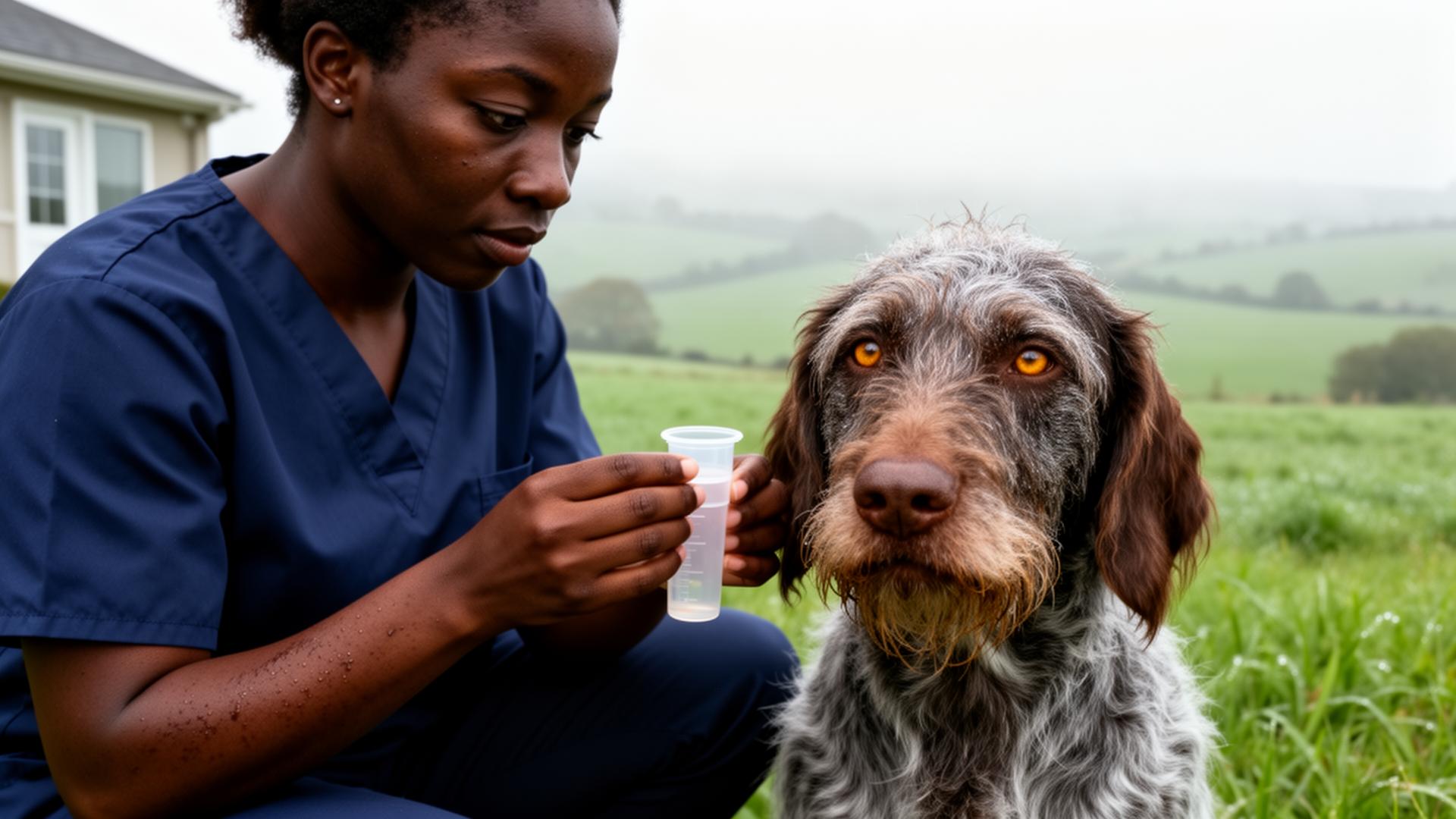
The team then split dogs into two groups based on a single number — whether their UACR at enrollment was below 2.0 or at/above 2.0 — and ran Cox proportional hazards and Kaplan–Meier survival analyses against demographics, bloodwork, and outcomes.
The results were lopsided in a way that's hard to ignore:
- Hazard ratio for death: 3.045 (95% CI 1.372–7.102) in the low-UACR group.
- Median survival: 189 days vs. 445 days for dogs above the cutoff (P = 0.008).
- Median time to CKD progression: 132 days vs. 445 days (P = 0.0002), where progression was defined as a >25% rise in serum creatinine.
- Most dogs had normal serum bicarbonate at enrollment, yet UACR was already abnormal — meaning the ammonia signal arrived before standard acid–base bloodwork caught up.
That last point is the quietly explosive one. It implies vets running a textbook senior panel could still be missing dogs who are actively spiraling.
Why this matters for your dog's next vet visit
CKD is one of the leading causes of death in older dogs. Roughly 1 in 10 senior dogs develops it, and breeds like Cocker Spaniels, Beagles, Cavaliers, Boxers, Bull Terriers, and Shih Tzus tend to show up over-represented in renal caseloads. Most owners only learn about the disease after a routine bloodwork panel comes back with a creatinine flag — by which point a meaningful chunk of kidney function is already gone.
A UACR test changes the math because it's:
- Non-invasive. It uses a standard free-catch urine sample. No needles, no sedation.
- Cheap relative to advanced biomarkers. Ammonia and creatinine are common laboratory assays; the ratio is just math.
- An early warning, not a confirmation. It can flag acid dysregulation while bicarbonate still looks normal.
- Actionable. Low UACR dogs are the exact subgroup most likely to benefit from alkali therapy (e.g., potassium citrate) and earlier dietary adjustments.

It also dovetails with a broader 2026 trend we've been tracking in canine longevity science. From the Dog Aging Project's 2026 metabolite study showing tiny blood molecules predict lifespan, to the Oregon State research on gut microbiome and cancer survival, the field is steadily moving from "what does this expensive scan show?" to "what does this routine sample already know?" The UACR work fits that pattern exactly.
What to ask your vet
The study is prognostic — it identifies dogs at higher risk — not yet a treatment trial. But the practical conversation has already shifted. If your dog has been diagnosed with IRIS stage 2, 3, or 4 CKD, it's reasonable to ask:
- "Can we add a urine ammonia-to-creatinine ratio to the next recheck?" Not every lab runs it as a standard panel yet; some larger reference labs and university hospitals already do.
- "If the UACR is under 2.0, would alkali therapy be appropriate now rather than waiting for serum bicarbonate to drop?" Harris's team explicitly frames UACR as a tool to identify dogs who might benefit from earlier targeted intervention.
- "What's our re-test cadence?" The study tracked dogs every ~3 months over a year. That's a reasonable real-world rhythm for stable CKD.
For dogs that aren't diagnosed yet but fit the risk profile — seniors, small breeds with known renal predisposition, dogs recovering from acute kidney injury, or dogs on long-term NSAIDs — talking to your vet about routine urinalysis (with ammonia, if the lab supports it) is a low-cost hedge.

The limits — and what comes next
It's worth being honest about what the study isn't. Fifty dogs is small. They were already on a renal diet, which itself influences urinary acid handling. Most were IRIS stage 2 (82%), so the data is strongest for early-to-moderate disease, not advanced end-stage CKD. And the analysis is observational — UACR predicts outcomes, but a randomized trial hasn't yet proven that acting on a low UACR (with alkali therapy or otherwise) changes survival in dogs.
What it does is build a strong, biologically coherent case for the next step: a larger, controlled trial of alkali supplementation in dogs stratified by UACR. The work was funded by the AKC Canine Health Foundation (grant #03030), which signals the breed-club world also sees this as a serious research direction.
The bigger picture
There's a quiet through-line in 2026 canine medicine: the most useful diagnostics are the cheapest ones we weren't paying enough attention to. A urine ratio. A drop of blood for a liquid biopsy. A short group training class for cognitive decline. None of these require new MRI suites or six-figure machines. They require asking better questions of samples we already collect.
If you've got a senior dog at home — especially one already on the CKD path — the takeaway is simple: at the next recheck, ask about UACR. The lab probably already has the assays. The math is trivial. And the answer might give you, and your vet, months of warning that the old bloodwork wouldn't.
Because in chronic kidney disease, every month of early intervention is a month of life that wouldn't have existed otherwise. And that's a number worth measuring.
Frequently Asked Questions
What is UACR in dogs?+
UACR is the urine ammonia-to-creatinine ratio. It measures how much ammonia your dog's kidneys are excreting relative to creatinine, which reflects how well the kidneys are clearing acid from the body. Note: in human medicine 'uACR' refers to albumin-to-creatinine — a different molecule.
Is a UACR test available at my regular vet?+
Not always as a routine panel yet. The ammonia and creatinine assays are common, but the ratio itself is still being adopted clinically. Larger reference labs and university veterinary hospitals are most likely to offer it; ask your vet to send the sample out if needed.
My dog's UACR is below 2.0 — what does that mean?+
In the NC State study, dogs with UACR <2.0 had roughly triple the risk of dying from kidney failure and faster disease progression. It doesn't mean a death sentence, but it identifies your dog as someone who may benefit from earlier, more aggressive intervention, such as alkali therapy. Discuss next steps with your vet.
What is alkali therapy for dogs with CKD?+
It's the use of alkalinizing agents like potassium citrate or sodium bicarbonate to counter the acid buildup (metabolic acidosis) that occurs as kidneys fail. It's already part of CKD management for some dogs, but UACR may help identify which dogs benefit most and when to start.
Which dog breeds are at higher risk for chronic kidney disease?+
Cocker Spaniels, Beagles, Cavalier King Charles Spaniels, Boxers, Bull Terriers, Shih Tzus, and Samoyeds are over-represented in renal caseloads, along with most senior dogs regardless of breed. Dogs on long-term NSAIDs or recovering from acute kidney injury are also at elevated risk.
Sources
Related Reading
Share this story
The PawPulse Newsroom is a small editorial team of dog owners, trainers, and pet-industry writers reporting on dog health, training, nutrition, and breed trends.
Medically reviewed by PawPulse Veterinary Review Board.
Pin this to your Healthy Happy Dogs board
Vet-vetted wellness, symptom guides, and senior dog care pins.
Liked this story?
Share it with someone who should read it.
More from Dog Health & Wellness

IVDD Revolution: How We Slashed Dachshund Back Pain by 74%!

Cavalier MVD Breakthrough: 3 Tools That Add Years to Their Lives
