Why Small Dogs Shouldn't Jump Off the Couch: A 2026 Vet-Backed Safety Guide
A viral 2026 case is changing how vets talk about small-breed safety at home. Here's why your sofa might be the riskiest thing in your dog's life — and the simple fixes that prevent almost every injury.

Quick Summary
- A new wave of 2026 veterinary cases is highlighting how dangerous routine jumps from sofas and beds can be for toy and small breeds.
- Toy poodles, Yorkies, Italian Greyhounds, Dachshunds and Chihuahuas have disproportionately fragile front legs.
- Ramps, steps and a few simple training cues prevent the majority of these injuries.
- Most small-breed fractures happen at home, not on walks.
- Early signs of injury are subtle — limping that "comes and goes" deserves a vet visit.
When nine-month-old toy poodle Ruby jumped off a couch this spring and fractured both of her front legs, her story spread fast through veterinary circles. It wasn't a freak accident. According to a 2026 case write-up in My Vet Candy, Ruby's injury is exactly the kind of small-breed orthopedic problem that vets are seeing more often as tiny dogs become more popular — and as the furniture they share with us gets taller.
If you live with a toy or small breed, this one matters. The good news: almost all of it is preventable.

Why Small Dogs Are Built to Break — Just a Little
Small dogs aren't just scaled-down Labradors. Their bones, especially in the front legs, are proportionally thinner relative to their body weight, and the radius and ulna of toy breeds have a famously sparse blood supply. That makes healing slower and complications — like non-union fractures — more common.
The breeds most commonly flagged in clinical case series include:
- Toy and Miniature Poodles
- Yorkshire Terriers
- Italian Greyhounds
- Pomeranians
- Chihuahuas
- Miniature Dachshunds (back issues more than front legs)
- Maltese and Papillons
A 16-inch jump for a Labrador is a non-event. The same drop for a 4 lb Yorkie is the rough biomechanical equivalent of an adult human leaping off a second-storey balcony onto concrete.
"But she does it every day…"
That's exactly the problem. Repeated micro-impacts add up. Many of the front-leg fractures vets see don't happen on the dramatic leap — they happen on the one landing where the dog twists slightly, lands on a slippery floor, or is already a little sore from the previous week.
The 2026 Case That Changed a Lot of Minds
Ruby's case stuck with the veterinary community because:
- She wasn't doing anything reckless — just hopping down from a couch.
- The fracture pattern affected both forelimbs, which is unusual and devastating.
- Her owners had no idea small breeds were so fragile.
It's a reminder that appearing energetic and athletic isn't the same as being structurally robust. A 6 lb dog launching off the sofa is putting astonishing force through wrists that are barely thicker than a pencil.
For a deeper look at how we under-estimate other small-breed health risks, see our piece on small dog breeds, and our growing library on dog health.
What Actually Prevents These Injuries
Forget the dramatic stuff. The fixes are almost embarrassingly simple — and they work.
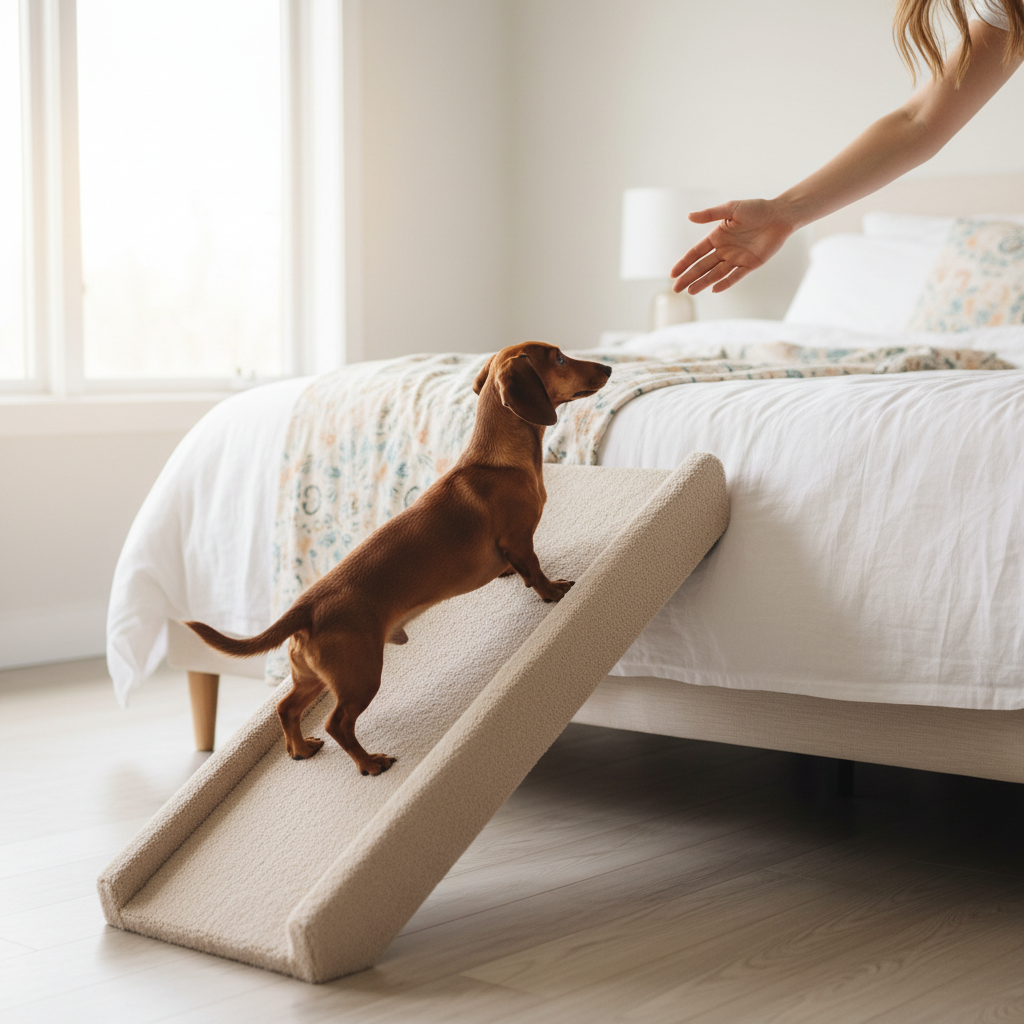
1. Add ramps and steps everywhere they jump
Pet ramps with a gentle incline (15–20°) and a non-slip surface are ideal. Steps work too, but ramps are easier on dogs who already have early elbow or shoulder soreness. Place them at:
- The sofa
- The bed
- The car (this is the single most under-rated one)
- Any window perch
2. Train an "off" or "wait" cue
A dog that pauses on the edge of the couch and waits for you to lift them down is a dog that won't fracture a leg this year. This is small-breed survival training, not optional polish. If you're starting from scratch, our puppy training section walks through the basics.
3. Fix your floors
Slippery hardwood and tile cause more small-dog injuries than any single piece of furniture. Runners, rugs and yoga mats in landing zones absorb impact and stop the dreaded twisting slip on landing.
4. Keep them lean
An extra pound on a 7 lb dog is roughly equivalent to a 25 lb gain on a person. Lean small dogs land better, recover faster, and have measurably fewer joint problems. (For more on the long-term benefits of keeping small dogs active and lean, our recent feature on lifelong exercise and cognitive decline in dogs is worth a read.)
5. Strength, not just exercise
Short, controlled "cavaletti" walks over low poles, gentle sit-to-stand reps, and balance work on a folded towel build the small stabiliser muscles around the wrists and shoulders. Two minutes a day is enough.
Spotting an Injury Early
The classic small-breed mistake is to assume a brief limp is "just a tweak". With toy breeds, every limp earns a vet visit. Watch for:
- Lifting one front leg at rest
- A limp that's worst first thing in the morning
- Reluctance to jump up (often more telling than reluctance to jump down)
- Yelping when picked up under the chest
- Subtle "tippy-toe" walking on the front feet
Important: This article is general guidance, not a diagnosis. Any persistent limp, swelling, or yelp deserves a hands-on assessment by your veterinarian — small-breed fractures can look deceptively mild from the outside.

What to Do Right Now (5-Minute Audit)
Walk through your home and answer honestly:
- Is your bed more than 18 inches off the floor with no ramp?
- Does your dog launch off the sofa unassisted?
- Do they jump out of the car?
- Are there long stretches of slippery floor in their main routes?
- Have you ever seen a brief limp that "went away on its own"?
Any "yes" is a small project for this weekend.
The Bigger Picture for 2026
As small breeds keep climbing the popularity charts — French Bulldogs, Pomeranians, Yorkies and Dachshunds are all in the U.S. top 20 this year — vets are bracing for more of these preventable injuries. The story isn't that small dogs are fragile and worrying. It's that we share homes designed for humans, and a few small adjustments make those homes properly safe for the smallest members of the family.
Ruby is recovering. With months of cage rest, surgery and rehab, she'll likely walk normally again. But her owners would tell you the same thing every orthopedic vet now repeats: the cheapest insurance for a small dog is a $40 ramp.
Key Takeaways
- Small breeds are biomechanically fragile in ways their personalities hide.
- Most fractures happen during routine jumps at home — not exercise.
- Ramps, rugs, training cues, and lean body weight prevent the vast majority of injuries.
- A "minor" limp in a toy breed is never minor — see your vet.
- Small adjustments compound: a few changes today protect a dog for life.
Frequently Asked Questions
How high is too high for a small dog to jump down?+
As a rule of thumb, anything taller than the dog's own shoulder height is risky for toy breeds, and anything over 18 inches deserves a ramp regardless of breed.
Are pet stairs or ramps better?+
Ramps are gentler on joints and better for dogs with any existing soreness. Stairs work well for confident, healthy dogs and take up less space.
My dog has been jumping off the bed for years with no problem — should I still change anything?+
Yes. Cumulative micro-trauma is exactly how chronic small-breed shoulder and elbow problems develop, and risk rises sharply after age 7.
What's the first sign of a small-breed orthopedic problem?+
Usually a brief, intermittent limp — often worse in the morning — or a sudden reluctance to jump up onto familiar furniture.
Sources
Related Reading
Share this story
Pin this to your Dog Lifestyle & Breeds board
Breed profiles, gear roundups, and dog-friendly travel inspo.
Liked this story?
Share it with someone who should read it.
More from Dog Breeds & Lifestyle

Bird Flu in Dogs 2026: Urgent H5N1 Warnings for Dog Owners

Dog Dementia Breakthroughs: Early Detection & New Hope for Australian Shepherds
