Going Blind From the Outside In: The 2026 Penn Vet Study Mapping PRCD in Dogs
A landmark 2026 Penn Vet imaging study finally charts how PRCD — the most widespread inherited blindness in dogs and a model for human retinitis pigmentosa — actually unfolds inside the eye.

For 50 years, veterinarians knew that progressive rod-cone degeneration (PRCD) slowly stole sight from more than 75 dog breeds — Poodles, Labradors, Cocker Spaniels, Portuguese Water Dogs, Australian Cattle Dogs and many more. What they did not know was the exact pattern: where the retina starts dying, how fast it spreads, and whether the human form of the disease follows the same script.
A new longitudinal study published in Experimental Eye Research (May 2026) from the University of Pennsylvania School of Veterinary Medicine answers all three questions. Using years of advanced multimodal retinal imaging, Penn Vet's Division of Experimental Retinal Therapies produced the first detailed map of how PRCD progresses — and the answer has real consequences for early diagnosis, breeding decisions and future gene therapies.
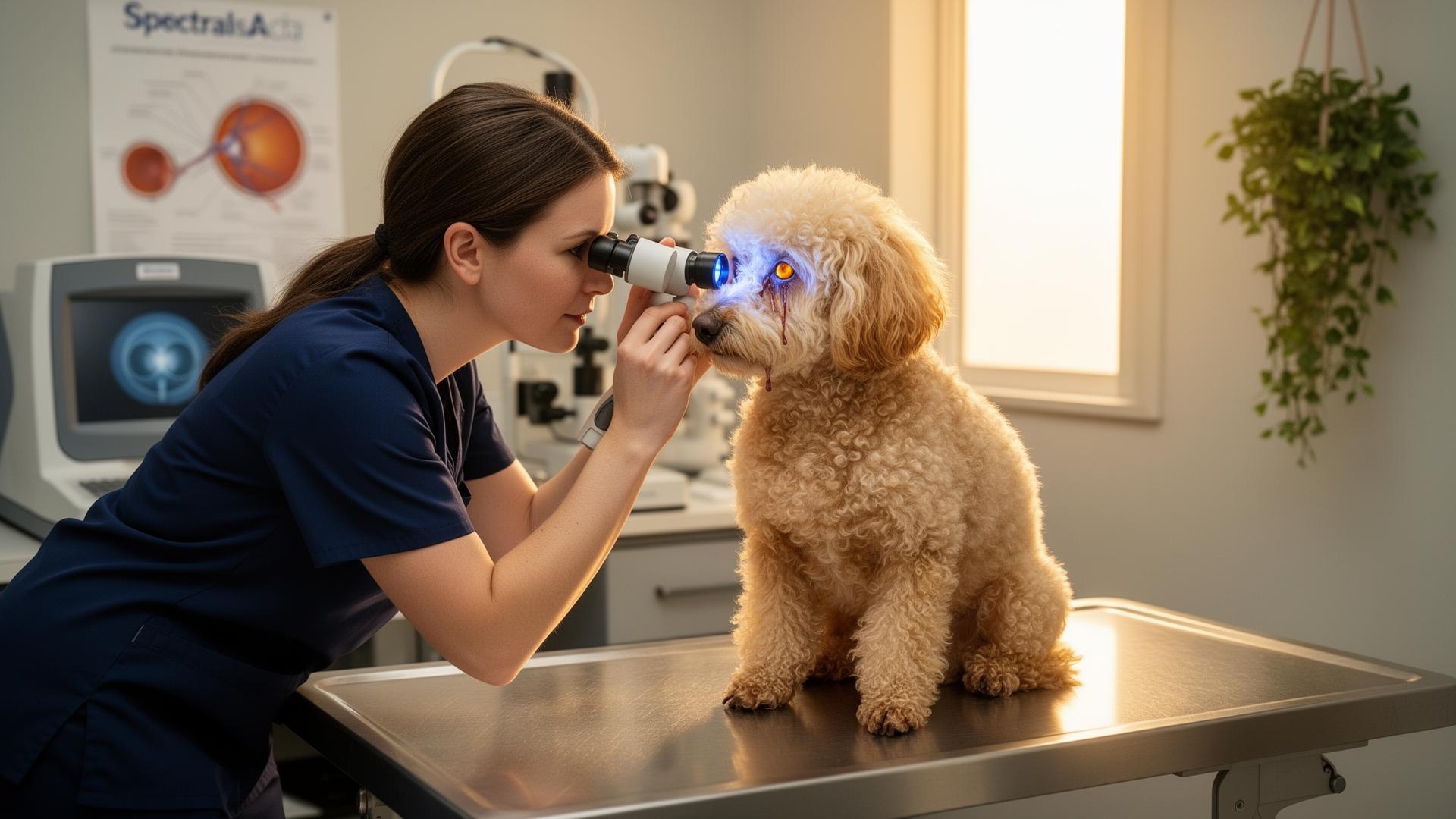 Slit-lamp examination of a Miniature Poodle — one of the 75+ breeds carrying the PRCD mutation.
What PRCD actually is
PRCD is an inherited mutation in the PRCD gene that disrupts the photoreceptors at the back of the eye — first the rods (responsible for low-light and peripheral vision), then the cones (color and central vision). Clinically, owners typically notice night blindness first: a dog that suddenly hesitates on dim stairs, bumps into furniture after sunset, or refuses to step outside in twilight.
In humans, the same biology produces retinitis pigmentosa (RP), an umbrella term for more than 120 genetic retinal diseases. PRCD-affected dogs have long been considered the most faithful naturally-occurring model for the human disease — which is exactly why mapping its trajectory matters far beyond veterinary medicine.
The Penn Vet finding: peripheral first, central last
Senior author Dr. Valérie Dufour and co-first author Dr. Yu Sato, working with PRCD pioneer Dr. Gustavo Aguirre and Dr. William Beltran, followed a population of PRCD-affected dogs over years with Spectralis Optical Coherence Tomography (OCT). They measured outer retinal thickness in concentric zones at multiple time points.
The trajectory turned out to be strikingly consistent across animals:
- Phase 1 — peripheral thinning. The outer ring of the retina (the part responsible for peripheral and low-light vision) begins to lose thickness first.
- Phase 2 — centripetal spread. The thinning advances inward toward the central retina in a reproducible wave.
- Phase 3 — central involvement. The area used for sharp, well-lit vision is the last to go, which is why many dogs still navigate familiar rooms long after they have stopped seeing in dim light.
That spatial pattern — outside in, slow, predictable — mirrors what ophthalmologists see in human PRCD-associated RP patients. The translational symmetry is the headline of the paper.
 Night blindness is usually the first sign of PRCD — long before owners notice anything in daylight.
Why a map of the disease changes care
Until now, a PRCD diagnosis was essentially a verdict with no timeline. The new map gives clinicians three concrete tools:
- Earlier detection. Knowing exactly where thinning starts means OCT scans can be aimed at the peripheral retina in at-risk breeds before behavioral symptoms appear.
- Better prognostic conversations. Owners can be told, with reasonable confidence, roughly how long their dog is likely to retain central, daylight vision after night blindness sets in.
- A measurable endpoint for trials. Future gene therapies need an outcome you can quantify. A reproducible thinning trajectory is that endpoint.
Penn Vet has already wired the findings into clinical practice through Dr. Dufour's new Retinal Health Clinic at Ryan Hospital, where client-owned dogs are now imaged and tracked using the same protocol.
Which breeds carry the highest risk
The PRCD mutation is autosomal recessive, meaning a dog needs two copies to develop disease — but carriers (one copy) can silently pass it on. Breeds with documented high carrier frequency include:
- Miniature, Toy and Standard Poodles
- Labrador Retrievers (especially working lines)
- Cocker Spaniels (American and English)
- Portuguese Water Dogs
- Nova Scotia Duck Tolling Retrievers
- Australian Cattle Dogs and Australian Shepherds
- Chesapeake Bay Retrievers
- Entlebucher Mountain Dogs and Finnish Lapphunds
A simple cheek-swab DNA test (Optigen / Wisdom Panel / Embark) reliably identifies clear, carrier and affected status. For breeders, the math is brutal but simple: never breed two carriers together.
 Among at-risk breeds, the eye itself looks normal until very late — imaging catches what the eye can't.
What you can do as an owner — today
- Test before you breed, test before you panic. A $100 DNA panel beats years of speculation.
- Watch for night blindness, not bumping in daylight. Hesitation on dim stairs, refusal to go out after dusk, or startling when approached in low light are the earliest behavioral red flags. Familiar daytime navigation can stay intact for a long time.
- Ask for OCT, not just an ophthalmoscope exam. Standard fundus exams miss early peripheral thinning. The Penn Vet study confirms that high-resolution OCT is the right tool, and many veterinary teaching hospitals now offer it.
- Don't rearrange the house once a diagnosis is made. Affected dogs map their environment by memory and smell. Move the couch and they look "blinder" overnight.
- Stay on the radar for gene therapy trials. A reproducible disease map is exactly the prerequisite that intervention trials need — the next 3–5 years will be active.
How this fits into the bigger picture of canine eye and brain research
The PRCD map joins a remarkable wave of 2026 canine science where naturally-occurring dog disease is reshaping human medicine — from the Manchester sebum study on Parkinson's detection to anti-PD-1 immunotherapy for oral melanoma. As with cognitive decline in senior dogs, the lesson is the same: tracking a disease precisely over time is what separates "we know it happens" from "we can do something about it." And just like the histotripsy breakthrough for bone cancer, the real value here is giving owners a measurable trajectory instead of a vague verdict.
Source: Sato Y, Dufour VL, Aguirre GD, Beltran WA, et al. Longitudinal multimodal imaging of progressive rod-cone degeneration in the canine retina. Experimental Eye Research, 2026. DOI: 10.1016/j.exer.2026.110201. Press release: University of Pennsylvania School of Veterinary Medicine, May 13, 2026.
Frequently Asked Questions
Which breeds should be tested for the PRCD mutation?+
Poodles (all sizes), Labrador and Chesapeake Bay Retrievers, American and English Cocker Spaniels, Portuguese Water Dogs, Nova Scotia Duck Tollers, Australian Cattle Dogs, Australian Shepherds, Entlebuchers and Finnish Lapphunds top the list. A cheek-swab DNA panel from Optigen, Wisdom Panel or Embark gives clear / carrier / affected status.
What is the very first sign of PRCD an owner might notice?+
Night blindness. Affected dogs hesitate on dim stairs, refuse to go outside at dusk, or startle when approached in low light — often for months before any daytime vision change appears.
How fast does PRCD progress?+
The Penn Vet study shows a slow, reproducible wave from the peripheral retina inward. Most dogs retain functional central daylight vision for years after night blindness begins, but the exact timeline varies by breed and individual.
Is there a cure or treatment yet?+
No approved cure exists in 2026, but the new disease map is a prerequisite for gene-therapy trials. The Penn Vet–Scheie Eye Institute pipeline is among the most active in the world.
Should I rearrange my home for a dog with PRCD?+
No — do the opposite. Dogs with progressive retinal disease rely on mental maps of furniture, scent trails and routine. Keep layouts, food bowls and bed locations constant, and add scent or texture cues at edges and stairs.
Sources
Related Reading
Share this story
Pin this to your Healthy Happy Dogs board
Vet-vetted wellness, symptom guides, and senior dog care pins.
Liked this story?
Share it with someone who should read it.
More from Dog Health & Wellness

Ozempic for Dogs? New Drug Trial Shows Promise for Canine Weight Loss

Is Your Senior Dog Showing These Subtle Signs? New Study Reveals How to Fight Dog Dementia!
