Sports, Walks and a Sharper Senior Dog: What the 2026 ELTE Study Reveals About Canine Dementia
An 858-dog Hungarian study just made the strongest case yet that an active life with you protects an aging dog's brain — and the breeds that benefit most may surprise you.

If you have ever watched an old dog stand in a doorway, forgetting which way they meant to go, you already understand why the new ELTE Eötvös Loránd University study matters. Published 27 April 2026 in Frontiers in Veterinary Science, it surveyed owners of 858 senior dogs from around the world and found that two everyday things — lifetime sports engagement and shared activities with the owner — were the single strongest protective factors against canine cognitive dysfunction (CCD).
 Lifetime sport — even gentle, weekend agility — was the most protective factor in the 858-dog ELTE survey.
The headline finding
The Budapest team, led by Csenge Anna Lugosi, Petra Dobos and Péter Pongrácz, used the validated Canine Cognitive Dysfunction Rating Scale (CCDRS) — 13 behaviors scored from 1 to 5, where a total of 50+ points means clinical dementia. Across the 858 dogs (all aged 7+), three associations stood out:
- Lifetime sports career — strongest negative association with CCD scores (p < 0.001).
- Joint activities with the owner — independently lowered CCD scores (p = 0.037).
- Owner attitude — dogs whose owners prioritized health and sound behavior, or breeding quality, scored lower; chasing fashionable or rare breeds had no effect at all (p = 0.830).
In plain English: dogs treated as sports companions — not "decoration", not "breeding stock" — aged better cognitively, regardless of breed.
Why working breeds get a head start
The researchers split the dogs into cooperative working breeds (retrievers, herders, pointers — bred to read human cues), independent working breeds (terriers, hounds, livestock guardians — bred to make their own decisions), and non-working breeds (toy breeds and mixes). The pattern was clean:
- Cooperative and independent working breeds had lower CCD scores even with only sporadic exercise. Centuries of selection for purposeful work appear to bake in some cognitive resilience.
- Toy breeds and mixed breeds benefited the most from joint activities with their owner. They start with no built-in "job", so the job you give them at home does the heavy lifting.
This dovetails with what we covered in our deep-dive on the 2026 UBC reversal-learning study, where breed clade — not raw IQ — predicted how dogs adapted when the rules changed mid-task.
 Low-impact exercise like swimming counts. The ELTE study didn't measure intensity — it measured engagement.
What "sports engagement" actually meant in the survey
This is where the study gets practical. Owners weren't asked whether their dog was a national agility champion — they were asked whether the dog regularly engaged in any of the following over their lifetime:
- Agility, obedience, dock-diving, IGP, flyball, herding trials, treibball
- Working roles (search-and-rescue, scent detection, gun-dog work, livestock guarding)
- Owner-led activities: long structured walks, hikes, biking, swimming, fetch sessions, trick training
The category that produced the lowest CCD scores wasn't "elite competitor" — it was "the owner showed up consistently". Three short walks a day with a 12-year-old Pug, daily fetch with a senior Lab, weekly nose-work classes with a graying terrier — those count. If your dog has ongoing physical-activity issues that limit walks, the related 2026 Librela vs. Galliprant arthritis trial is worth reading before you give up on movement entirely.
The owner-attitude finding nobody talks about
Buried in the results is a subtler — and arguably more uncomfortable — pattern. Owners were asked what mattered to them when they chose their dog. Two priorities tracked with sharper old-age cognition:
- Health and sound behavior as the top criterion (p = 0.042)
- Breeding quality from a verifiable, ethical source (p = 0.004)
Owners who picked their dog because it was fashionable, rare, or aesthetically striking showed no association with cognitive outcomes either way. That doesn't mean those dogs are doomed — it means the things that protect a dog's brain in old age start before you bring them home, and continue every single day after. If you're weighing a flat-faced breed in particular, our piece on the 2026 Cambridge BOAS study covers how anatomy compounds the issue.
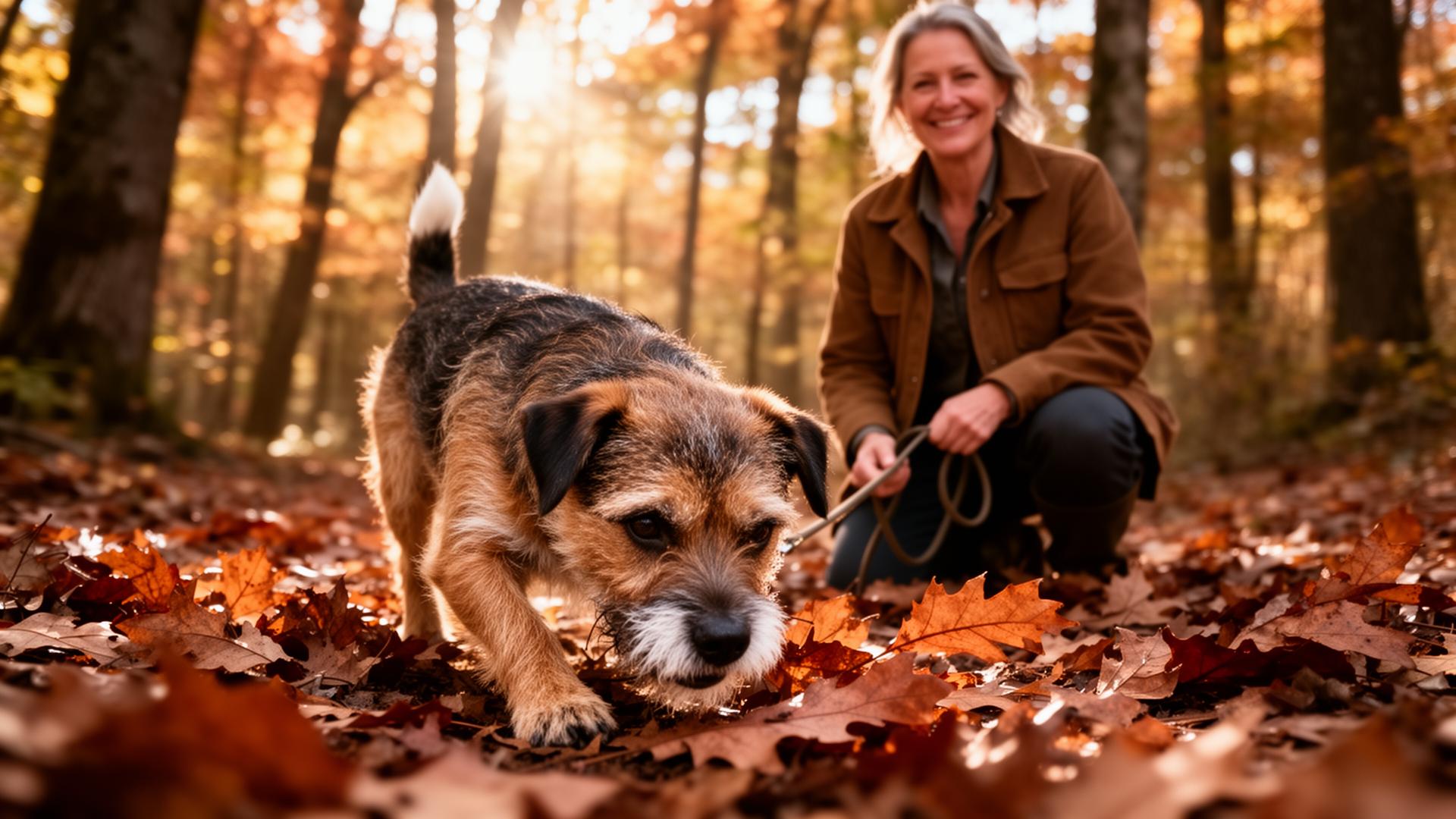 Scent work — even casual backyard nose games — gives independent breeds the decision-making load they were bred for.
What this means for your senior dog this week
The ELTE results aren't a prescription, but they line up with the broader literature on the role of early-life enrichment and adult brain reserve. Practical takeaways:
- Don't retire the activity when the muzzle goes gray. The protective effect was a lifetime pattern — keep moving with your dog as long as their joints allow.
- Match the activity to the breed group. Sporting and herding breeds want a job; terriers and hounds want a problem to solve; toys and mixes want you.
- "Joint activity" beats parallel activity. A dog jogging next to a treadmill isn't the same as a dog jogging with you. Engagement was the variable that moved the needle.
- Watch for the early CCD signs. Aimless wandering, getting "stuck" in corners, broken sleep, new house-soiling, or loss of recognition — get a vet check. Many of these have treatable non-dementia causes too.
The bottom line
For the first time, an 858-dog dataset puts a number on what good owners have always suspected: the walk you didn't feel like taking, the fetch session you almost skipped, the rainy-day nose-work game in the kitchen — those are the interventions. They are also free. In a field where most "brain support" sells in 30-day jars, the ELTE team handed us the most evidence-backed canine cognitive supplement of 2026, and it fits in a leash.
Frequently Asked Questions
How old is 'senior' in this study?+
All dogs were 7 years or older. CCD prevalence rises sharply after that — over 50% of dogs older than 15 are affected.
Is it too late to start exercising my 11-year-old dog?+
No. Earlier studies (and a 2026 short-course trial cited by the ELTE team) found that even a 3-month structured exercise and cognitive-training program improved problem-solving and social behavior in senior dogs.
What counts as 'sport' if my dog has never competed?+
Anything regular and structured: long walks, hikes, swimming, fetch, scent-work games, trick training, dock-diving, agility, obedience, herding. Engagement matters more than intensity.
Does breed actually predict dementia risk?+
Breed function (working vs. companion) influenced the protective effect of exercise more than breed size. Toy and mixed breeds benefited most from joint owner activity.
What are the early signs of canine cognitive dysfunction?+
Aimless wandering, getting stuck in corners or doorways, disrupted sleep, new house-soiling, increased anxiety, and reduced recognition of familiar people. Always rule out pain, sensory loss and other illness first.
Sources
Related Reading
Share this story
Pin this to your Healthy Happy Dogs board
Vet-vetted wellness, symptom guides, and senior dog care pins.
Liked this story?
Share it with someone who should read it.
More from Dog Health & Wellness

Doggy Dementia Breakthrough: New At-Home Test Catches CCD Early!

H5N1 Bird Flu: What Dog Owners *Must* Know Now
