Monthly Shot vs Daily Pill: 2026 Trial Says Both Work for Dog Osteoarthritis Pain
A randomized 2026 trial used objective force plate gait analysis to show that monthly bedinvetmab injections work as well as daily grapiprant for canine osteoarthritis pain — giving owners two real first-line options.

For decades, daily NSAIDs were the only painkiller with strong evidence behind them for canine osteoarthritis (OA). A new randomized, double-blind 2026 trial published in Scientific Reports just changed that conversation — using a robotic-style measurement called force plate gait analysis (FPGA), researchers showed that a once-monthly antibody injection works just as well as a daily oral NSAID for relieving OA pain in dogs.
If your dog limps after rest, hesitates on stairs, or no longer leaps onto the couch, this study matters for you. Here is what the trial found, why FPGA is a big deal, and how to talk to your vet about both options.
 Subtle gait changes — slower walking, weight shifted off a sore leg — are how OA pain shows up at home long before a dog whimpers.
The study at a glance
Researchers enrolled 32 large-breed dogs (over 20 kg, at least 1 year old) with OA limited to the hips and/or stifles. Dogs were randomized 1:1 to one of two treatment arms:
- Bedinvetmab (Librela) — a once-monthly subcutaneous injection of a canine monoclonal antibody that blocks nerve growth factor (NGF), plus a daily oral placebo.
- Grapiprant (Galliprant) — a daily oral NSAID that selectively blocks the EP4 prostaglandin receptor, plus a monthly saline injection.
Neither owners nor investigators knew which dog received what. Force plate gait analysis and owner-completed questionnaires were collected at baseline, then every 14 days for two months.
Why force plate gait analysis matters
Most OA studies rely on owner questionnaires, which are powerful but subjective — we want our dogs to feel better, and that hope can color what we report. A force plate measures the actual ground reaction forces a dog produces with each step. A painful limb is unloaded; less weight goes through it. The two key numbers are:
- Peak vertical force (PVF) — the maximum push the limb makes against the ground.
- Vertical impulse (VI) — total force over time the limb is in contact with the ground.
An increase of about 3.5% from baseline in PVF is considered a clinically meaningful improvement. This trial is the first to evaluate bedinvetmab against a comparator using that objective yardstick.
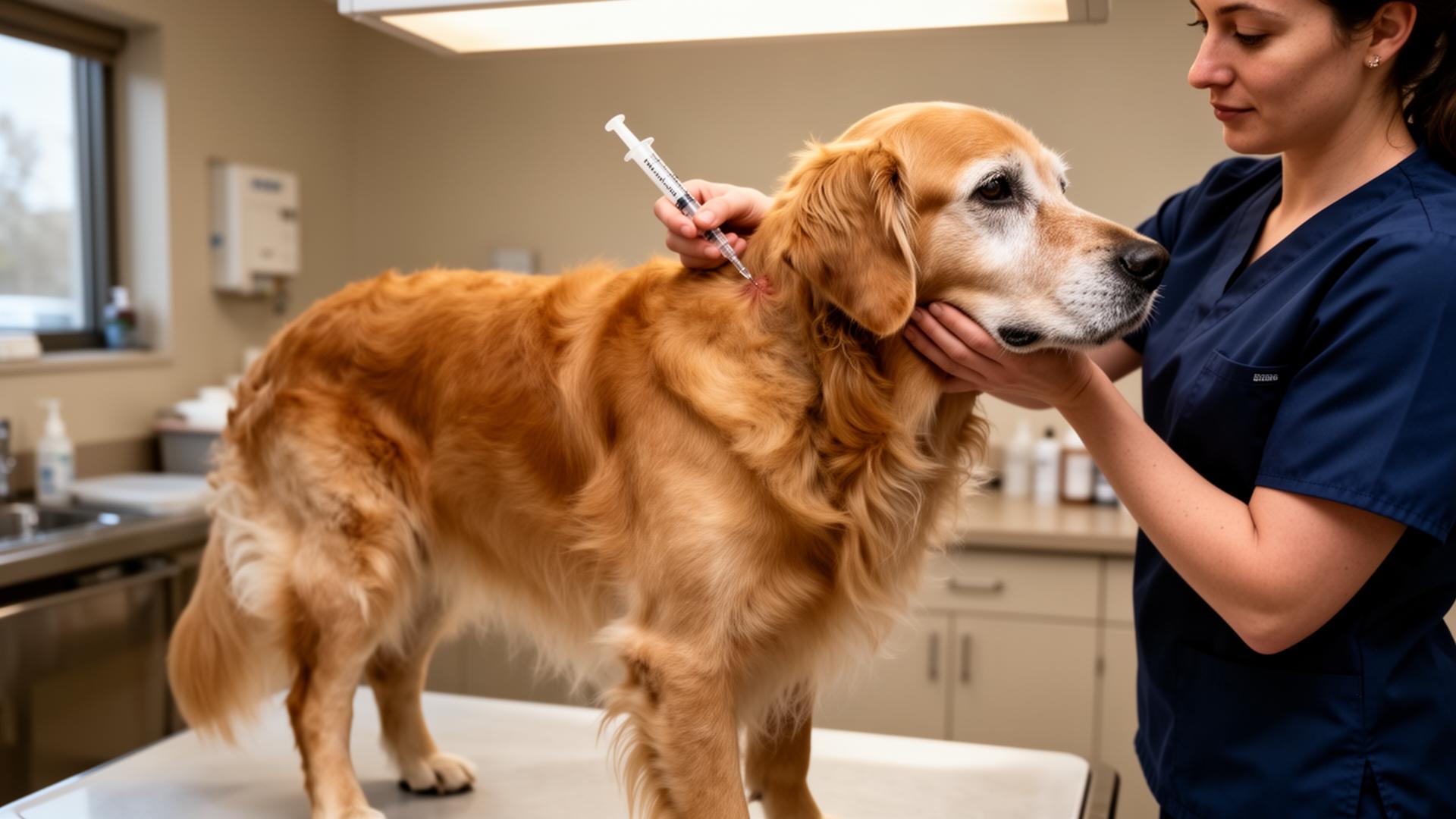 Bedinvetmab is a canine monoclonal antibody given once a month between the shoulder blades, sparing dogs a daily pill.
What the numbers showed
At day 42 — the pre-specified primary endpoint — the FPGA treatment success rates were:
- Bedinvetmab: 68.8% of dogs hit the success threshold (95% CI 41.3–89.0)
- Grapiprant: 56.3% of dogs hit the success threshold (95% CI 29.9–80.2)
The difference between groups was 12.5%. Because the upper bound of the 90% confidence interval (18.8%) sat below the pre-specified non-inferiority margin of 21.25%, the authors concluded bedinvetmab is non-inferior to grapiprant. In plain terms: it works at least as well.
Both groups also improved significantly on owner-reported scores (Canine Brief Pain Inventory, Liverpool Osteoarthritis in Dogs, and a quality-of-life measure), and adverse events stayed within each drug's known safety profile.
What this means for your dog
OA is far more common than most owners realize — roughly 20–37% of adult dogs show clinical signs, and a 2024 NC State study found radiographic OA in about 40% of dogs aged 8 months to 4 years. The takeaway from this trial is not that one drug is superior; it is that owners now have two genuinely first-line choices:
- Pick the daily NSAID (grapiprant) if your dog tolerates oral meds well, you want a low-cost option, and you appreciate the fast on/off control of a daily pill.
- Pick the monthly antibody (bedinvetmab) if your dog hates pills, has GI sensitivity, or you want one less thing to remember every morning.
Either way, the medication is only one leg of the stool. Weight management, structured exercise, joint supplements, and rehab work all amplify what any pain drug can do — a point we explored in our look at how lifetime activity protects senior dogs from cognitive decline, and one we will keep returning to.
 Daily structured walking — even short, gentle outings — keeps OA-affected joints moving and supports any pharmacological plan.
How to spot OA pain at home
The earlier you catch it, the more treatment options stay open. Watch for:
- Stiffness on rising that loosens after a few minutes of walking
- Reluctance to jump onto the couch, into the car, or up the stairs
- A shift in posture — a roached back, a wider stance, or weight thrown forward
- Slower pace on walks, or stopping to sit unprompted
- Subtle behavior changes: irritability when touched, less play, a quieter dog
These signs are easy to write off as "just getting old." They are not. They are pain — and pain is treatable. If you have a flat-faced or large breed, the threshold for asking your vet should be even lower; we covered breed-specific risks in our piece on BOAS in 14 brachycephalic breeds, and the same principle applies here: don't normalize discomfort.
What to ask your vet
Bring this study to your next appointment if your dog has been diagnosed with OA, or if you suspect it. Useful questions:
- Is my dog a candidate for either bedinvetmab or grapiprant given their age, weight, and other meds?
- Are there reasons (breed, kidney values, prior surgery) to prefer one over the other?
- What baseline bloodwork do we need before starting?
- How will we measure whether the treatment is actually working — and at what point do we change course?
Behavioral context also matters: anxiety can amplify how a dog perceives pain, which is one reason we keep an eye on the long shadow of early-life separation anxiety when planning chronic-care treatment.
The bigger picture
For years, owners with NSAID-intolerant dogs faced a hard choice: tolerate breakthrough pain, or rotate through opioids and adjuvants with their own baggage. The 2026 FPGA trial puts an objective stamp on what real-world clinics have been seeing — bedinvetmab is a legitimate first-line option, not a fallback. Combined with newer thinking on enrichment and movement (as in the 2026 MDPI shelter-dog welfare study), the picture for senior and OA-affected dogs is the brightest it has been in a generation.
If you have noticed your dog slowing down lately, this is the year to bring it up. The tools are better than they have ever been.
Frequently Asked Questions
Is bedinvetmab (Librela) safer than NSAIDs like grapiprant?+
Each drug has a different safety profile. Bedinvetmab avoids the GI and kidney concerns associated with NSAIDs but has its own monitoring considerations, particularly in dogs with neurological signs. Grapiprant is one of the gentler NSAIDs on the GI tract. Your vet will pick based on your dog's full health picture.
How quickly will my dog feel better?+
In this 2026 trial, both groups showed measurable gait improvement within 14 days of starting treatment, and gains continued through day 42 and beyond. If you see no improvement at all by 4–6 weeks, talk to your vet about adjusting the plan.
Can I switch from grapiprant to bedinvetmab (or back) later?+
Yes. Many vets do exactly that — for example, if a dog stops tolerating an oral NSAID, or if a monthly injection schedule no longer fits the household. Always do this under veterinary guidance with a short washout if recommended.
Does my dog still need joint supplements and exercise if they're on these drugs?+
Absolutely. Pain medication is one piece of OA management. Maintaining a lean body weight, doing controlled daily walks, and adding physiotherapy or hydrotherapy where possible all multiply the benefit of any pharmacological treatment.
Is this study big enough to trust?+
It's a small trial (32 dogs analyzed) but its strength is the use of objective force plate gait analysis rather than only owner questionnaires. Results align with several prior larger studies on each drug individually, which is why treatment guidelines (AAHA, WSAVA, COAST) already list both as first-line.
Sources
Related Reading
Share this story
Pin this to your Healthy Happy Dogs board
Vet-vetted wellness, symptom guides, and senior dog care pins.
Liked this story?
Share it with someone who should read it.
More from Dog Health & Wellness

Doggy Dementia Breakthrough: New At-Home Test Catches CCD Early!

H5N1 Bird Flu: What Dog Owners *Must* Know Now
