Why Your Dog’s Runny Nose Won’t Quit: The 2026 Leipzig Idiopathic Rhinitis Study
A new 2026 prospective study from Leipzig and Ghent shows that allergy panels and bacterial cultures rarely solve chronic nasal discharge in dogs — and why owner compliance is the real weak link.

Your dog has had a runny nose for weeks. The discharge keeps coming back. Your vet has ruled out kennel cough, foreign bodies, and dental disease — and still no clear answer. A new prospective study from Leipzig and Ghent universities, published May 2026 in the journal Animals, helps explain why so many of these cases end up labeled idiopathic rhinitis (IR) — and why the tests owners often demand may not actually help.
What the new study actually looked at
Researchers Sarah Rösch and Gerhard Ulrich Oechtering enrolled 46 dogs with chronic nasal discharge. Every dog received the full diagnostic gauntlet: blood work, whole-body CT, nasal endoscopy, mycological testing, and biopsies. They then split the dogs into five groups: 13 with idiopathic rhinitis, 10 with malignant nasal tumors, 6 with benign tumors, 8 with other inflammatory nasal diseases, and 9 healthy controls.
The headline finding: IR is still a diagnosis of exclusion, and no single inexpensive test can confirm it.
 Chronic nasal discharge in non-brachycephalic breeds is the hallmark of idiopathic rhinitis.
Why "just allergies" is probably the wrong answer
Many owners — and some clinicians — assume a snotty nose that won't quit must be an allergy. The Leipzig team tested that directly by measuring allergen-specific IgE superclasses in every dog.
The result was striking: positive IgE results were just as common in healthy controls and in dogs with nasal tumors as in IR dogs. Worse, IR dogs that tested IgE-positive did not consistently improve on steroid therapy. The authors' conclusion is blunt — these blood allergy panels are "neither diagnostic nor predictive" for canine IR.
That matters because allergen panels are widely marketed to worried pet parents. For chronic nasal disease, this 2026 data says they should not be the first or only step.
Sinusitis, turbinate damage, and bacteria — also unreliable signals
CT scans showed sinusitis and turbinate destruction in many IR dogs. Logically, you'd expect bacterial cultures from those inflamed cavities to come back positive with a clear pathogen. They didn't. No correlation was found between sinusitis, turbinate destruction, and culture results.
In plain English: finding bacteria in a chronic dog nose doesn't tell you whether antibiotics will help. The bacteria are often passengers, not drivers.
The role of CT and endoscopy
If blood tests and cultures aren't enough, what is? The study reinforces a now-standard workflow:
- Whole-body CT to rule out tumors and dental disease (a hidden tooth root abscess can mimic IR for months)
- Rhinoscopy to inspect the nasal cavity and look for foreign bodies, fungal plaques, or masses
- Biopsy with histopathology to distinguish lymphoplasmacytic rhinitis from neoplasia
- Aspergillus serology plus direct visualization for fungal infection
Only when all of these are negative does "idiopathic rhinitis" become the working diagnosis.
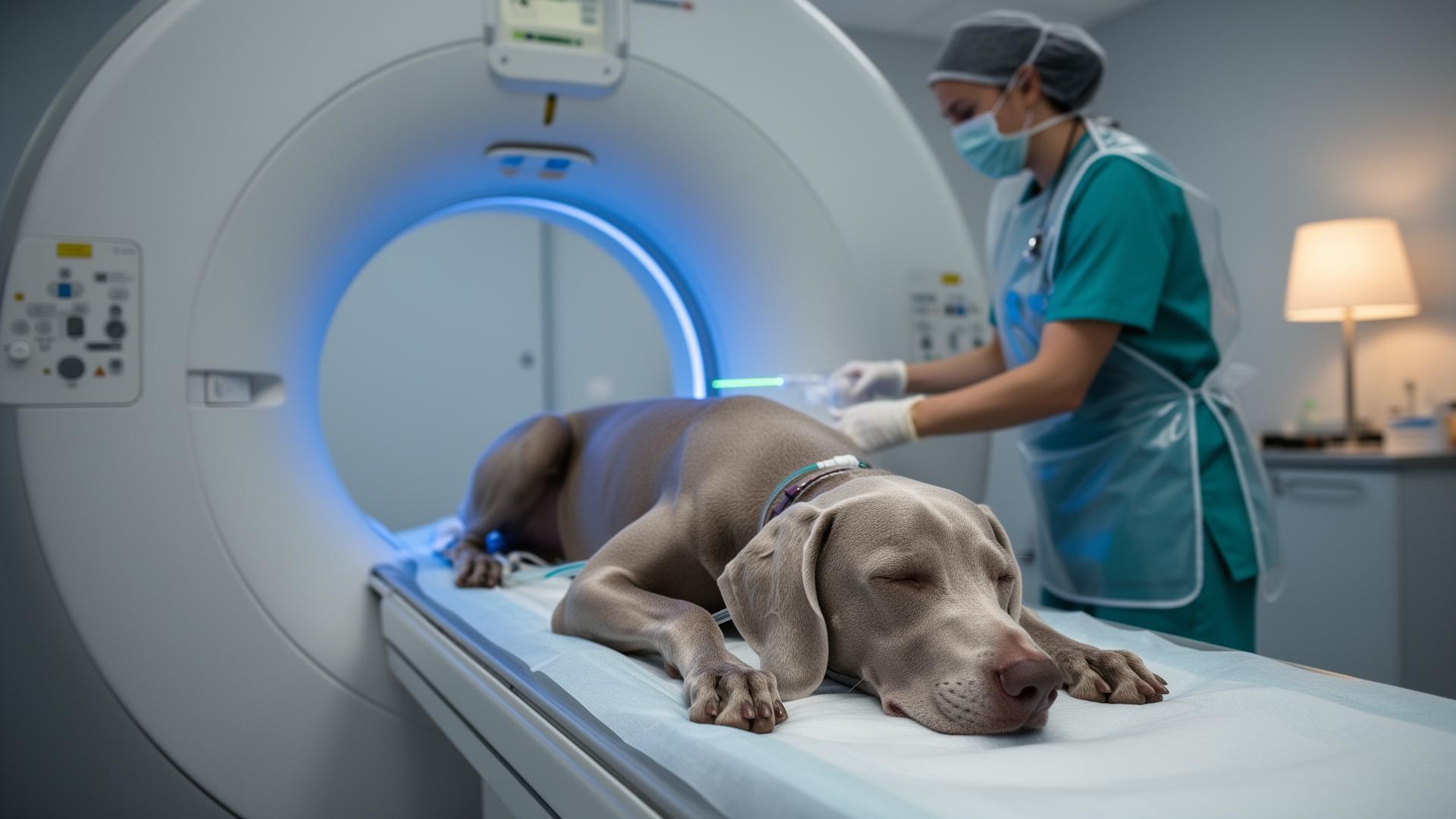 Whole-body CT is now considered essential to rule out tumors and dental disease before labeling a case idiopathic.
The breed pattern nobody talks about
Every IR dog in the study was non-brachycephalic — no Bulldogs, Pugs, or French Bulldogs in this group. That fits a broader picture: flat-faced breeds tend to develop a different family of upper-airway problems, dominated by BOAS and related structural disease, rather than the chronic inflammatory pattern seen in long- and medium-nosed dogs.
If your dog is a Beagle, Spaniel, Retriever, or sighthound with months of nasal discharge, IR should be on the differential list. If you have a brachycephalic breed, the conversation usually goes a different direction.
The owner-compliance problem
One of the most uncomfortable findings: owners of IR dogs had the lowest compliance with treatment and follow-up of any group. The authors believe many owners perceive the condition as a harmless cold and quietly disengage.
That's a problem because untreated chronic rhinitis can progress to permanent turbinate destruction, secondary sinusitis, and reduced quality of life. The nose isn't a cosmetic organ for a dog — it's the primary sensory channel they use to read the world. Long-term loss of nasal function affects appetite, behavior, and even emotional processing, similar to what we're learning about how dogs decode emotion through scent and sound.
What owners should actually do
Based on the study and current consensus, a practical playbook looks like this:
- Document the discharge — frequency, color, one nostril or both, presence of blood. Take phone videos for your vet.
- Don't start steroids on your own. A two-week steroid course before the work-up will invalidate biopsies and skew test results.
- Push for imaging early if discharge persists beyond 3–4 weeks despite a clean initial exam.
- Be patient with the diagnosis. IR is identified by what it isn't, which takes time and often more than one test.
- Stick with the treatment plan. Topical nasal therapy and immunomodulation work best when used consistently for months, not weeks.
If anxiety about repeated vet visits is part of why follow-up slips, working on calm vet-visit and crate handling skills early makes a measurable difference for chronic-care patients.
Key takeaways
- Canine idiopathic rhinitis remains a diagnosis of exclusion, confirmed only after CT, endoscopy, and biopsy
- Allergy blood panels (IgE) are not diagnostic or predictive for IR — positive results show up just as often in healthy dogs
- Sinusitis and turbinate destruction seen on CT do not correlate with bacterial culture results, so cultures alone shouldn't drive antibiotic choices
- All IR dogs in the study were non-brachycephalic — flat-faced breeds usually have a different underlying problem
- Owner compliance is the weak link — chronic rhinitis is not a "harmless cold" and untreated cases can cause lasting damage
A note on next steps
If your dog has had nasal discharge for more than a few weeks, this study is a good prompt to ask your vet two specific questions: do we need advanced imaging? and are we testing for the right things, or just the easy things? For senior dogs in particular, distinguishing chronic rhinitis from nasal tumors changes everything — and tumor risk rises with age, much like the broader cognitive and physical decline patterns reported in older dogs.
This article is for educational purposes only and is not a substitute for veterinary advice. Always consult a licensed veterinarian about your dog's specific symptoms.
Frequently Asked Questions
How long is a runny nose in a dog considered chronic?+
Most vets consider nasal discharge lasting more than 3–4 weeks despite initial treatment to be chronic and worth a deeper diagnostic work-up.
Can a blood allergy test diagnose my dog’s rhinitis?+
According to the 2026 Leipzig study, allergen-specific IgE testing is not diagnostic or predictive for idiopathic rhinitis. Healthy dogs and dogs with tumors test positive at similar rates.
Does my dog really need a CT scan?+
For persistent unexplained nasal discharge, yes. CT is the best non-invasive way to rule out nasal tumors, dental disease and severe sinusitis before labeling a case idiopathic.
Will antibiotics fix my dog’s chronic snotty nose?+
Usually not on their own. Bacteria found in a chronically inflamed dog nose are often secondary, and cultures did not predict treatment response in the study.
Is idiopathic rhinitis dangerous?+
It is not immediately life-threatening, but untreated chronic rhinitis can lead to permanent turbinate destruction, persistent sinusitis and reduced quality of life.
Sources
Related Reading
Share this story
Pin this to your Healthy Happy Dogs board
Vet-vetted wellness, symptom guides, and senior dog care pins.
Liked this story?
Share it with someone who should read it.
More from Dog Health & Wellness

Doggy Dementia Breakthrough: New At-Home Test Catches CCD Early!

H5N1 Bird Flu: What Dog Owners *Must* Know Now
