Rickettsia finnyi: The New Tick-Borne Illness Vets Just Confirmed in Dogs (2026 NC State Alert)
A new tick-borne pathogen named Rickettsia finnyi has just been confirmed in feverish dogs by North Carolina State University researchers — right as peak tick season kicks off. Here is what every dog owner needs to know between May 15 and July 15.

Peak tick season — roughly May 15 through July 15 — is officially open, and this year it arrives with a fresh warning. A team led by associate research professor Barbara Qurollo at North Carolina State University’s College of Veterinary Medicine has confirmed a previously unrecognized pathogen, Rickettsia finnyi, in dogs that were brought to clinics with fever and general malaise. The bacterium was named for the very first dog it was identified in, and researchers believe it is being spread by the lone star tick (Amblyomma americanum) — a species that is steadily expanding its range north and west across the United States.
 Tick season peaks May–July, when dogs and owners spend the most time in tall grass and wooded edges.
If your dog hikes, camps, romps through tall grass, or even just patrols a brushy backyard, this discovery changes how seriously you should take a mid-summer fever.
What is Rickettsia finnyi?
Rickettsia species are a family of intracellular bacteria — the same group that causes Rocky Mountain spotted fever in people and dogs. Rickettsia finnyi is the newest addition to that family. According to Qurollo, the affected dogs in the NC State case series had a fever and simply “didn’t feel well,” which is exactly why their owners brought them in. There were no flashy, breed-specific signs and no obvious bite wound that screamed "tick disease."
So far, no human cases have been documented, but veterinarians are clear about a long-standing principle: dogs often act as sentinels for diseases that later show up in people. Watching what happens in canine patients now is one of the cheapest forms of public-health surveillance we have.
Why the lone star tick matters
The lone star tick is aggressive, fast-moving, and — unlike many tick species — actively hunts its hosts rather than passively waiting on a blade of grass. Climate shifts and changing land use have pushed its range steadily northward over the past decade, which means owners in regions that historically saw very few ticks are now finding them on their dogs after a single walk.
Lone star ticks already transmit ehrlichiosis, tularemia, and the alpha-gal syndrome that causes red-meat allergy in humans. Adding Rickettsia finnyi to that ledger is a meaningful update for any vet practicing in the southeastern, midwestern, and lower-northeastern United States.
Symptoms to watch for
The clinical picture in the NC State dogs was deliberately non-specific, which is part of what makes this illness tricky:
- Fever (often the first and sometimes only obvious sign)
- Lethargy — a dog that suddenly will not get off the couch
- Reduced appetite
- General “off” behavior — owners often describe it as “he just isn’t himself”
- Possible joint stiffness or reluctance to jump (common across rickettsial diseases)
Because these signs overlap with everything from a mild GI upset to early canine cognitive dysfunction in senior dogs, context matters. Recent time in tick habitat is the single biggest clue. If your senior dog has been slowing down for months, that is a different conversation — one we cover in our guide to the 2026 Adelaide study showing a 5-week class can improve sleep in dogs with cognitive decline. But an acute fever 5–14 days after a hike? That is a tick story until proven otherwise.
 Persistent fever plus a recent tick exposure is the combination veterinarians want to see urgently.
How to remove a tick correctly
If you find a tick, technique matters more than speed-panic. Use fine-tipped tweezers, grasp the tick as close to your dog’s skin as possible, and pull straight up with steady, even pressure. Do not twist, do not squeeze the body, and skip the folk remedies — petroleum jelly, matches, and nail polish all increase the chance that the tick regurgitates pathogens into the bite.
After removal:
- Drop the tick in a small sealed container or zip bag (alcohol optional). Your vet may want to identify it, especially if symptoms appear later.
- Clean the bite site with mild antiseptic.
- Note the date. Most tick-borne illnesses incubate for 5–21 days; a calendar entry helps your vet enormously.
- Wash your hands thoroughly — and remove gloves if you used them.
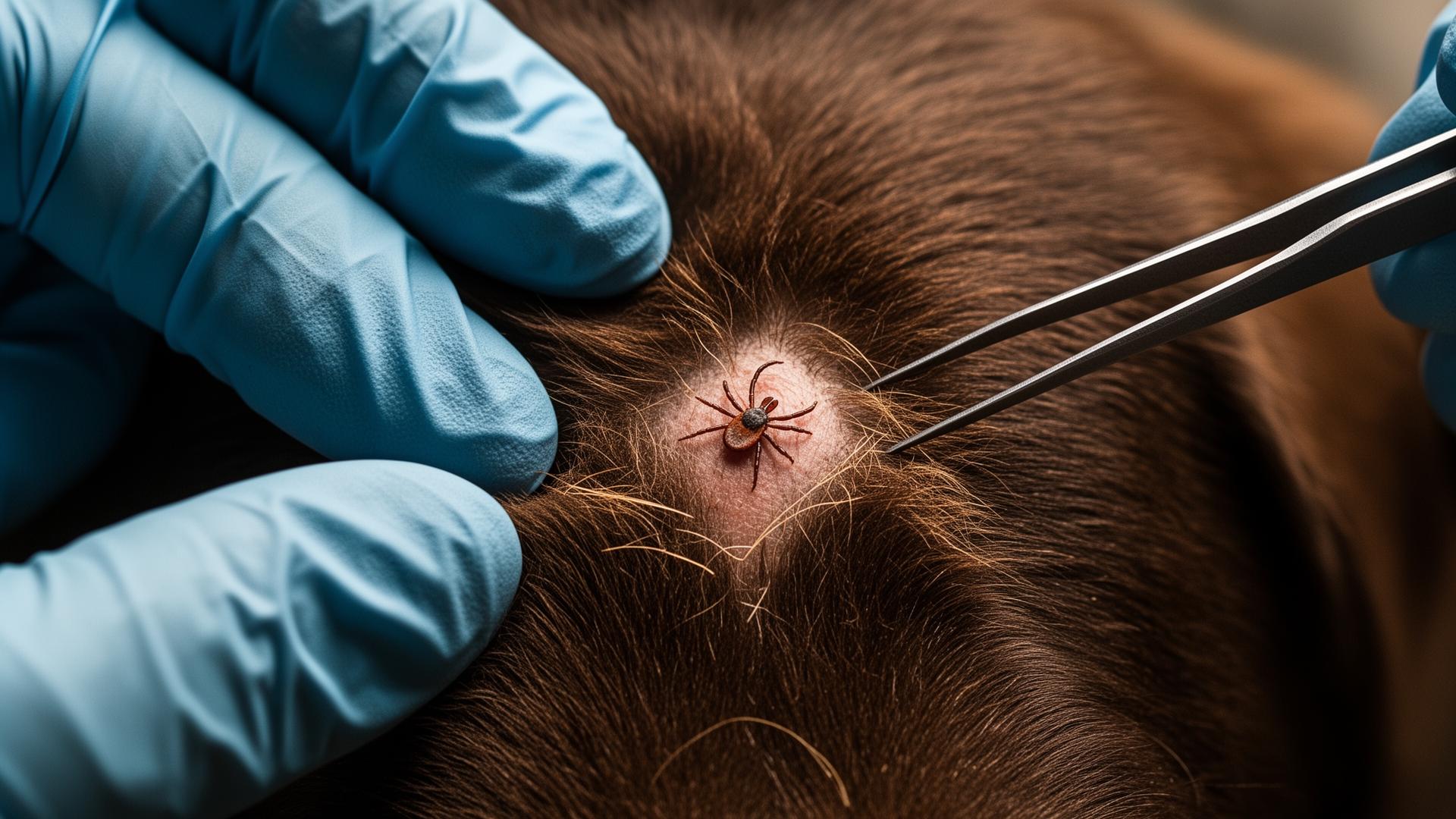 Fine-tipped tweezers, gloves, and steady upward pressure — no twisting, no folk remedies.
Prevention is the whole game
Treatment for rickettsial disease in dogs is usually a course of doxycycline, and most patients respond well when caught early. But the cleaner answer is to avoid infection entirely:
- Use a vet-approved tick preventive year-round. Modern oral isoxazolines (afoxolaner, fluralaner, sarolaner, lotilaner) kill ticks before they can transmit most pathogens. Topical fipronil/permethrin combinations and prescription tick collars are reasonable alternatives. Whatever you choose, do not skip months — ticks are now active well outside the old May–July window in many regions.
- Check after every outing. Run your hands carefully over your dog’s ears, neck, armpits, groin, between toes, and around the tail base. A fine-toothed flea comb helps on long-coated breeds.
- Keep your yard hostile to ticks. Mow tall grass, clear leaf litter at the woodland edge, and consider a 3-foot wood-chip or gravel barrier between lawn and brush.
- Talk to your vet about a 4Dx-style annual screen. These in-clinic blood tests already catch heartworm, Lyme, ehrlichia, and anaplasma; broader rickettsial panels can be added.
 A five-minute comb-through on the porch after every hike is one of the highest-value habits a dog owner can build.
Why this matters beyond one tick season
A single newly named pathogen rarely re-shapes how we care for dogs overnight. But Rickettsia finnyi lands at a moment when canine health research is moving fast on multiple fronts. The same year veterinarians at NC State are mapping a new tick disease, the Dog Aging Project has shown that tiny molecules in a dog’s blood can predict lifespan — and that the gut microbiome shapes both anxiety and how well dogs survive cancer. Other 2026 work is even targeting breathing problems in flat-faced breeds with a single shot.
The connecting thread is that owners now have far more leverage than they did even five years ago. Catching a tick-borne fever in week one, instead of week three, is the kind of small win that compounds across a dog’s lifetime.
When to call your vet
Call the same day if your dog:
- Has a temperature above 103.5°F (39.7°C)
- Was in tick country in the last three weeks and is acting unwell
- Has a tick you can’t fully remove, or a bite site that is hot, red, and growing
- Is a puppy, senior, or immunocompromised dog with any sign of illness
Bring the tick if you have it. Bring the date you found it. Bring a one-sentence note on where your dog has been. Those three things — more than any single blood test — are what help your vet land on the right diagnosis fast.
Frequently Asked Questions
Can humans catch Rickettsia finnyi from their dog?+
No human cases have been confirmed so far. Researchers note that dogs often act as early warning sentinels for diseases that may later appear in people, which is why vets are tracking this closely.
How long after a tick bite do symptoms appear?+
For most rickettsial diseases in dogs, symptoms appear roughly 5 to 21 days after the bite. Log the date you found and removed the tick and share it with your vet.
Which tick preventive is best for my dog?+
There is no single best option. Modern oral isoxazolines (afoxolaner, fluralaner, sarolaner, lotilaner) kill ticks within hours. Topical fipronil/permethrin and prescription tick collars also work. Discuss your dog's age, lifestyle, and region with your veterinarian.
Should I use petroleum jelly or a lit match to remove a tick?+
No. Both methods increase the chance the tick regurgitates pathogens into the bite. Use fine-tipped tweezers, grasp at the skin, and pull straight up with steady pressure.
Do indoor dogs need tick prevention?+
Yes, especially during peak season. Ticks hitchhike on humans, other pets, and through screens. Year-round protection is the current veterinary recommendation in most U.S. regions.
Sources
Related Reading
Share this story
Pin this to your Healthy Happy Dogs board
Vet-vetted wellness, symptom guides, and senior dog care pins.
Liked this story?
Share it with someone who should read it.
More from Dog Health & Wellness

Cavalier MVD Breakthrough: 3 Tools That Add Years to Their Lives

IVDD Breakthrough: New Protocol Slashes Dachshund Risk by 63%!
