The 84% Number: Texas A&M's 2026 Study Just Proved Your Dog Is More Anxious Than You Think
Dr. Bonnie Beaver analyzed 43,000+ dogs from the Dog Aging Project and found over 84% show at least mild fear or anxiety in everyday situations — and most owners never bring it up at the vet.

More than 8 in 10 dogs are anxious — and most owners never bring it up
A trembling Lab during a thunderstorm. A Spaniel who freezes when a stranger says hello. A terrier who flattens at the sight of the vacuum. For years, owners have written these moments off as "just their personality." A May 2026 study out of Texas A&M College of Veterinary Medicine & Biomedical Sciences, drawing on 43,000+ dogs from the Dog Aging Project, says something far more uncomfortable: more than 84% of dogs show at least mild signs of fear or anxiety in everyday situations.
Lead author Dr. Bonnie Beaver, a board-certified veterinary behaviorist, calls it one of the most comprehensive snapshots of canine fear ever assembled — and a wake-up call for how rarely behavior comes up in the average vet visit.

What the 43,000-dog dataset actually found
Beaver pulled owner-reported behavior data from tens of thousands of dogs of every age, breed, size, and region — not a single clinic population. After excluding learned dislikes around grooming (nail trims, baths), the headline numbers were stark:
- 84%+ of dogs displayed at least mild fear or anxiety in routine situations.
- The most common triggers were unfamiliar people and unfamiliar dogs — exactly what your dog meets on every walk.
- Reactions ranged from subtle (lip licking, turning away, "shutting down") to dramatic (trembling, hiding, escape attempts).
- Severity often escalated when dogs were repeatedly forced through situations they couldn't cope with.
Beaver was blunt about how far this can go: she has seen storm-phobic dogs "chew through brick walls" trying to get inside. "Once it reaches that level," she said, "it is almost impossible to manage."
Why owners keep missing it
The Texas A&M data points to a second, quieter finding: dogs are anxious far more often than their humans realize. Part of that is biology — dogs whisper before they bark. Part of it is the brachycephalic problem we covered last week: flat-faced breeds physically can't show the same micro-expressions, and humans misread them. But a lot of it is structural: behavior almost never makes it onto a routine vet exam unless the owner raises it first.
Beaver's recommendation is simple — add a behavior questionnaire to pre-appointment paperwork, the same way clinics already ask about diet and stool. Catching escalation early is the difference between a dog who needs a new walking route and a dog who needs medication and a board-certified behaviorist.
The 7 fear signals owners most often dismiss
These are the "whispers" before a dog escalates to growling, snapping, or bolting. If you see two or more clustered together, your dog is telling you they are not okay:
- Lip licking when there is no food around
- Whale eye — whites of the eyes showing as the dog turns its head away
- Yawning in cool, calm rooms
- Tucked tail or low, slow tail wag
- Freezing mid-step, especially on greetings
- Lifting a single front paw while staring at the trigger
- Sudden scratching or sniffing the ground (displacement behavior)
Pair this list with what we wrote about the 50 cm proximity rule from the Russian AI ethogram study: a dog that suddenly closes distance to you for no reason is often telling you they feel unsafe.
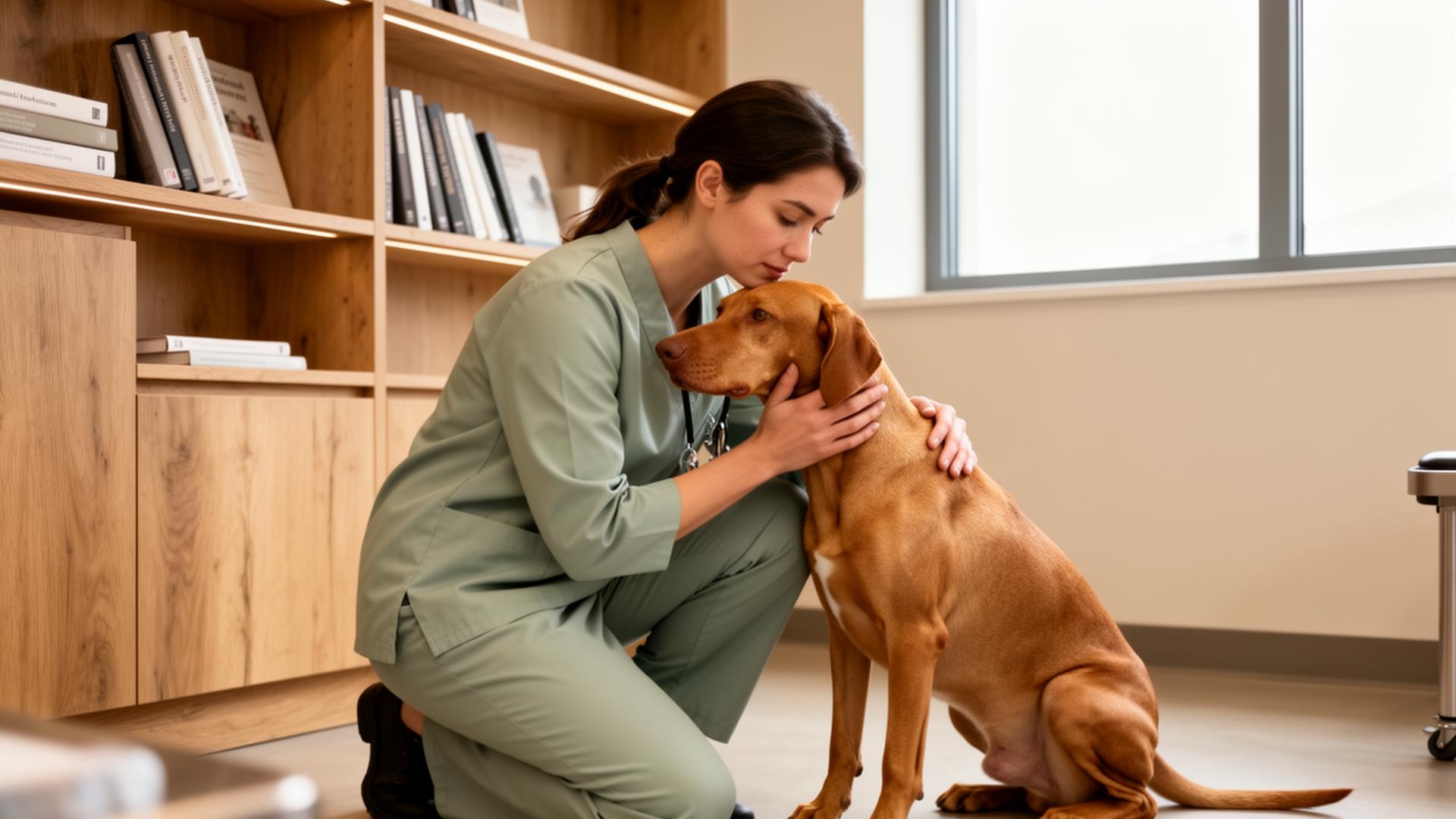
When "just shy" becomes a clinical problem
Beaver is careful to say 84% does not mean 84% of dogs need medication. Most are showing normal, short-lived stress responses to a normal, occasionally scary world. The red flag is duration and intensity:
- The reaction is lasting longer than it used to (minutes turn into hours).
- The reaction is more intense (hiding turns into destruction; growling turns into snapping).
- The dog stops recovering between triggers — they're stuck "on."
- New triggers are appearing without obvious learning history.
If any of those apply, the next call isn't to a trainer who promises "balanced" methods or e-collars. It is to your vet — and ideally a referral to a veterinary behaviorist (DACVB) who can rule out pain, thyroid issues, and other medical drivers before talking about behavior modification or anxiolytics.
What actually helps at home (evidence-based, not Instagram-based)
You can't desensitize a dog who is already over threshold. The job at home is to keep them under threshold long enough to learn:
- Cap the day's stress budget. Skip the dog park on storm-forecast days. Walk at 6 a.m. instead of 6 p.m. in a busy neighborhood.
- Build a safe space. A covered crate or a closet with white noise reduces auditory stress for storm and firework phobics.
- Use food puzzles, not free meals. Licking and sniffing are self-soothing — a frozen Kong does more for a wound-up dog than a 5-mile walk.
- Pair triggers with great food, at distance. This is classical counterconditioning. Stranger appears → roast chicken rains down. Stranger disappears → chicken stops. Repeat at a distance your dog can handle.
- Avoid flooding. "Just letting him meet people" is the single fastest way to turn shyness into reactivity.
For dogs who can't make progress with environmental management alone, modern veterinary medicine has solid options: SSRIs like fluoxetine, situational meds like trazodone for fireworks, and structured force-free desensitization protocols. None of that is failure — it's the same logic we use for human anxiety.

The bigger picture: anxiety is a welfare issue, not a personality quirk
Beaver's study lands at a moment when the field is converging on the same point from multiple angles. The Copenhagen training ethics study showed that aversive methods correlate with worse welfare outcomes. The 2026 GeroScience trial on group training for canine cognitive dysfunction showed structured social enrichment measurably calms older dogs. And the DSTU ethogram research is now putting numbers on stress signals humans used to argue about.
Put them together and the message is consistent: chronic stress shortens dogs' lives, suppresses their immune systems, and quietly erodes the relationship most owners think they have with their pet. The 84% number isn't there to scare you. It's there to give you permission to take the trembling, the hiding, the lip licking seriously — and to bring it up at the next vet visit before it becomes the kind of problem that's "almost impossible to manage."
Your dog has been telling you. The research just caught up.
Frequently Asked Questions
What does the Texas A&M 84% dog anxiety statistic actually mean?+
It means that across 43,000+ dogs in the Dog Aging Project dataset, more than 84% displayed at least mild fear or anxiety responses in everyday situations like meeting strangers or other dogs. It is not a diagnosis of clinical anxiety disorder — it is a measure of how often normal dogs encounter and react to stress.
Who is Dr. Bonnie Beaver and why does this study carry weight?+
Dr. Bonnie Beaver is a professor of behavior in the Department of Small Animal Clinical Sciences at the Texas A&M College of Veterinary Medicine & Biomedical Sciences and a past president of the American Veterinary Medical Association. She is one of the most cited veterinary behaviorists in the United States, which makes a single-author study of this size unusually authoritative.
What are the earliest signs of fear or anxiety in dogs?+
Lip licking with no food present, yawning in a calm room, 'whale eye' (whites showing), tucked tail, freezing on greetings, lifting one front paw while staring at a trigger, and sudden ground-sniffing or scratching. These 'whispers' usually appear long before growling or snapping.
When should I take my dog to a veterinary behaviorist instead of a regular trainer?+
When fear or anxiety is escalating in duration or intensity, when the dog is no longer recovering between triggers, when new triggers are appearing without obvious cause, or when aggression has appeared. A board-certified veterinary behaviorist (DACVB) can rule out medical causes and prescribe medication alongside a behavior plan — something a regular trainer cannot do.
Does this mean most dogs need anxiety medication?+
No. Beaver explicitly notes the 84% figure does not equal 84% needing clinical treatment. Most dogs benefit from environmental management — reducing trigger exposure, adding enrichment, building safe spaces. Medication is reserved for dogs whose anxiety is chronic, escalating, or interfering with welfare despite good management.
Sources
Related Reading
Share this story
The PawPulse Newsroom is a small editorial team of dog owners, trainers, and pet-industry writers reporting on dog health, training, nutrition, and breed trends.
Medically reviewed by PawPulse Veterinary Review Board.
Pin this to your Healthy Happy Dogs board
Vet-vetted wellness, symptom guides, and senior dog care pins.
Liked this story?
Share it with someone who should read it.
More from Dog Health & Wellness

IVDD Revolution: How We Slashed Dachshund Back Pain by 74%!

Cavalier MVD Breakthrough: 3 Tools That Add Years to Their Lives
