The 50 cm Rule: How Russia's New AI System Finally Puts a Number on Dog Anxiety
A May 2026 study from Don State Technical University unveils the first AI-backed method for measuring canine anxiety — built around a deceptively simple metric: the distance between your dog's paws and your feet. Here's what it found, and how to run a rough version at home.

Most owners can tell when their dog is "off" — the slight tremble before a thunderstorm, the lip lick at the vet, the way a rescue pup glues herself to your ankle in a crowded park. What they can't do is measure it. And until now, neither could most behaviorists.
That gap is exactly what a team at Don State Technical University (DSTU) in Russia, working with the Institute of Ethnology and Anthropology of the Russian Academy of Sciences, set out to close. In a study published in late May 2026, they unveiled the country's first AI-backed system for quantifying canine anxiety — built around something deceptively simple: how far your dog chooses to sit from your feet.

Editor's note: This article summarizes the May 26, 2026 DSTU press release and the original RIA Novosti coverage. Always pair behavioral observation with a licensed veterinarian's assessment.
The problem: "anxious" has never had a number
Ask ten trainers to score the same dog's anxiety on a 1–10 scale and you'll get ten different answers. Project lead Anna Fomina, associate professor at DSTU's Department of Biology and General Pathology, was blunt about it in the university's press release: existing assessments "rely heavily on subjective expert judgment," and there are "no precise quantitative parameters for canine anxiety."
That subjectivity has real consequences. Shelters mislabel adoptable dogs as "aggressive." Service-dog programs wash out candidates who were really just under-socialized. And owners load up on calming chews for a dog who is actually in pain, not in panic.
The DSTU team wanted hard numbers. They started with one variable almost no one had thought to measure systematically: the distance between a dog and its owner's feet.
The 50–60 cm "calm zone"
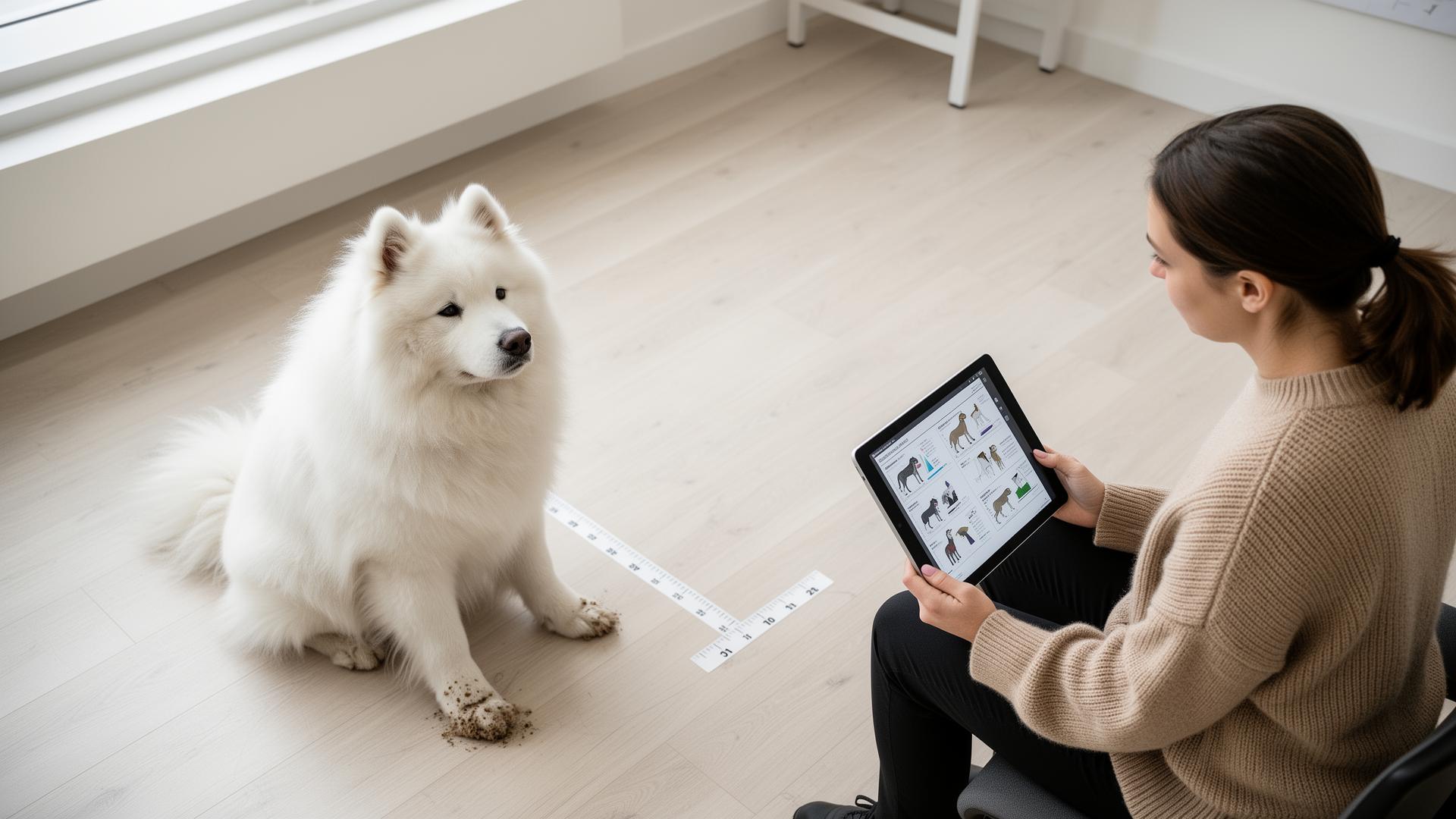
Across breeds and body sizes, the researchers found a strikingly consistent pattern when dogs were observed in a quiet, low-stimulus room with their owner seated:
- Calm dogs of nearly every breed parked themselves about 50–60 centimeters away — close enough to feel connected, far enough to relax.
- Small anxious dogs crowded in tight, often pressed against shoes or wrapped around ankles.
- Large anxious dogs did the opposite, drifting to the maximum distance the room allowed, watching the exits.
"The 'human–dog' distance turned out to be highly sensitive to a dog's anxiety and aggression levels," Fomina explained. It's the kind of finding that sounds obvious in hindsight — until you realize most behavior intake forms have never asked the question.

If your dog is one of those small breeds that velcroes to you in every new environment, this is also a good moment to revisit how early socialization shapes adult fear — we covered the latest evidence in our piece on the hidden language dogs use to signal trust.
What the AI actually watches for
Distance was just the entry point. The DSTU team paired it with a neural-network video analysis pipeline trained to flag a specific catalog of micro-behaviors filmed under calm conditions. The markers it learned to recognize include:
- Trembling
- Tongue protrusion ("tongue flick")
- Excessive blinking
- Nose licking and lip licking
- Paw lifting
- Heavy panting in a cool room
- Vocalization (whining, low grumbles)
- Stretched lip corners in large breeds
- Tucked tails in small breeds
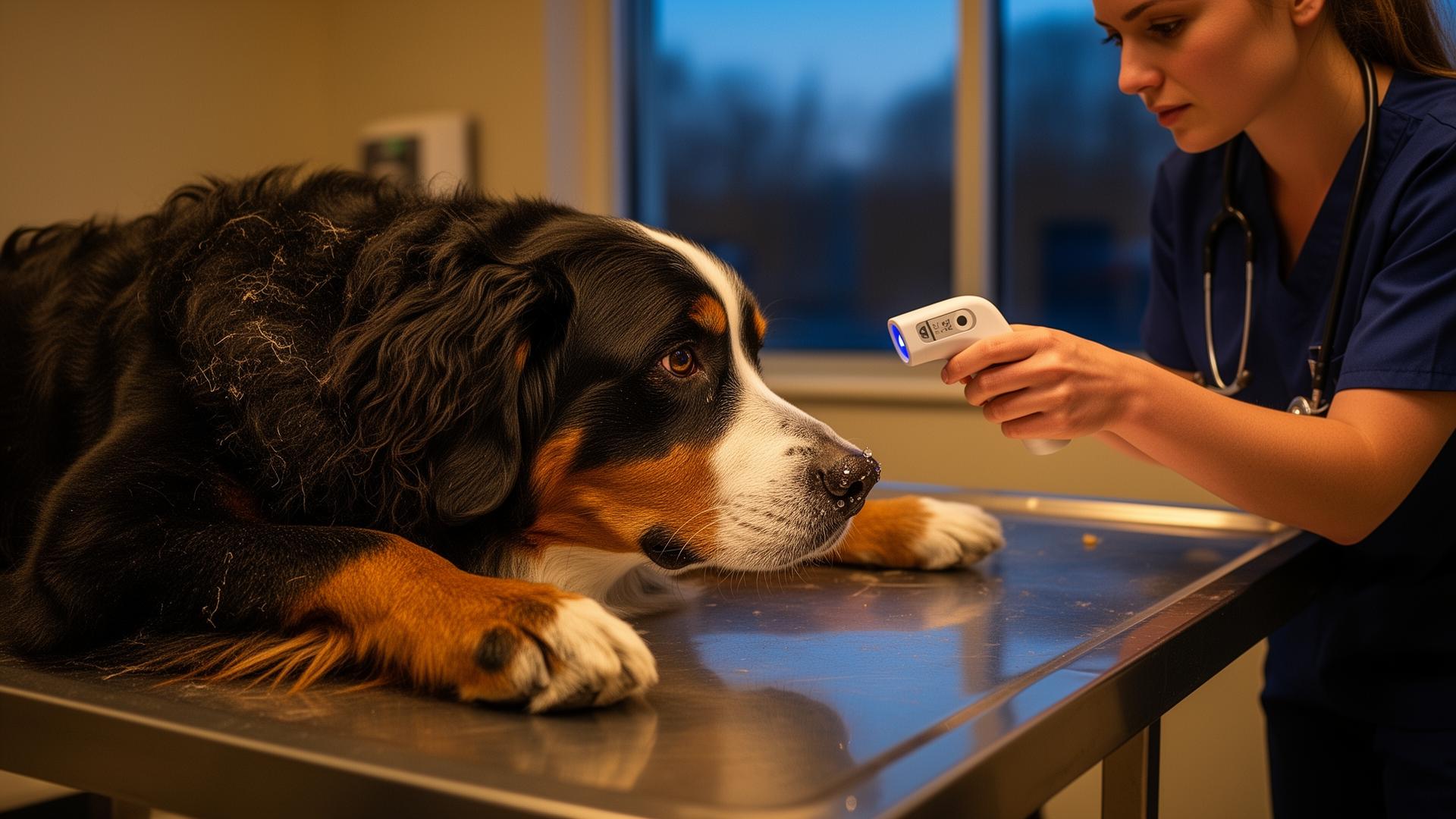
To make sure the algorithm wasn't just picking up on excitement, the team validated each session with physiological ground truth: nose-surface temperature and pulse rate, both of which spike during sympathetic-nervous-system arousal. Only dogs whose physiology and behavior agreed were used to train the classifier.
The output is something the researchers call ethograms — illustrated "behavior cards" mapping the postures, gestures and facial micro-expressions of a calm dog versus an anxious or excitable one. Think of them as the canine equivalent of the FACS coding system humans use to study micro-expressions in people.
Why this matters beyond Russia
Alexey Ermakov, director of DSTU's Institute of Living Systems, frames the practical payoff in three buckets:
- Pet owners get a tool that can distinguish genuine anxiety from breed-typical aloofness or simple over-arousal — the difference between needing a behaviorist and needing more enrichment.
- Working-dog programs — service, search-and-rescue, guide — can screen candidates earlier and stop investing 18 months of training in a dog whose nervous system was never going to cope.
- Shelters get an objective way to predict whether a stray will adapt to a foster home, instead of relying on a single stressed kennel assessment.
That third point connects directly to the broader 2026 push for evidence-based shelter evaluation, which we examined in our deep dive on how to vet a dog rescue before you trust it with a life after the Miranda's Rescue scandal.
How to use the "50 cm rule" at home — today
You don't need a neural network to run a rough version of the DSTU test in your living room. Try this over the next week:
- Sit on the floor or a low couch in a quiet room, no toys, no food, no TV.
- Let your dog choose where to settle. Don't call them.
- After 5 minutes, measure (or eyeball) the distance from your feet to their nearest paw.
- Note any of the micro-signs above: lip licks, paw lifts, blinks, panting in a cool room.
- Repeat 3–4 times over different days.
A dog who consistently lands in the 50–60 cm zone, with relaxed ears and a soft mouth, is telling you their baseline is good. A dog who either glues to you or retreats to the doorway, especially while showing two or more micro-signs, is flagging chronic low-grade anxiety — the kind that's worth raising with your vet before it hardens into reactivity.
For dogs whose anxiety appears tangled with cognitive decline — disrupted sleep, pacing at night, increased clinginess in old age — the DSTU markers pair powerfully with the cognitive-dysfunction interventions from the May 2026 GeroScience trial we covered in old dogs, new tricks: group training for canine dementia.
What's still unknown
The DSTU work, funded by Russian Science Foundation grant No. 24-28-01561, is genuinely exciting — but it's a methodology paper, not a finished product. A few honest caveats:
- Sample size and breed mix haven't been published in a peer-reviewed English-language journal yet; most reporting traces back to the university's own press service.
- The neural-network classifier hasn't been independently replicated outside the DSTU lab.
- Distance norms may shift in multi-dog households or with dogs raised primarily outdoors, where the "owner's feet" anchor is less central.
None of that diminishes the core insight: anxiety in dogs has measurable physical signatures, and we now have a credible blueprint for capturing them with consumer-grade video. Expect to see the next generation of pet cameras and smart collars quietly fold these markers into their "stress detection" features within the next 18 months.
In the meantime, the 50 cm rule is free, repeatable, and — for once — backed by something more rigorous than a TikTok trend.
Frequently Asked Questions
What is the DSTU dog anxiety study?+
A May 2026 study from Don State Technical University that uses a neural network to score canine anxiety by combining the dog–owner sitting distance with nine documented micro-behaviors, validated against physiological markers like nose temperature and pulse rate.
Why does 50–60 cm matter?+
Across breeds, calm dogs naturally chose to rest about 50–60 cm from their seated owner. Small dogs sitting much closer or large dogs sitting much farther were strong predictors of underlying anxiety in the study's sample.
Can I use this method at home?+
Yes, in a rough form. Sit quietly in a low-stimulus room, let your dog choose where to settle, measure the distance, and watch for repeated lip licks, paw lifts, blinking, trembling or tucked tails over several sessions.
Is the AI system available to consumers?+
Not yet. The DSTU work is currently a research methodology. Expect smart collars and pet cameras to integrate similar behavioral markers within the next 12–18 months.
Does this replace a veterinarian?+
No. The method is a screening and observation tool. Any dog showing chronic anxiety signs should be evaluated by a licensed veterinarian or veterinary behaviorist to rule out pain, endocrine issues, or other medical causes.
Sources
Related Reading
Share this story
The PawPulse Newsroom is a small editorial team of dog owners, trainers, and pet-industry writers reporting on dog health, training, nutrition, and breed trends.
Medically reviewed by PawPulse Veterinary Review Board.
Pin this to your Healthy Happy Dogs board
Vet-vetted wellness, symptom guides, and senior dog care pins.
Liked this story?
Share it with someone who should read it.
More from Dog Health & Wellness

IVDD Revolution: How We Slashed Dachshund Back Pain by 74%!

Cavalier MVD Breakthrough: 3 Tools That Add Years to Their Lives
